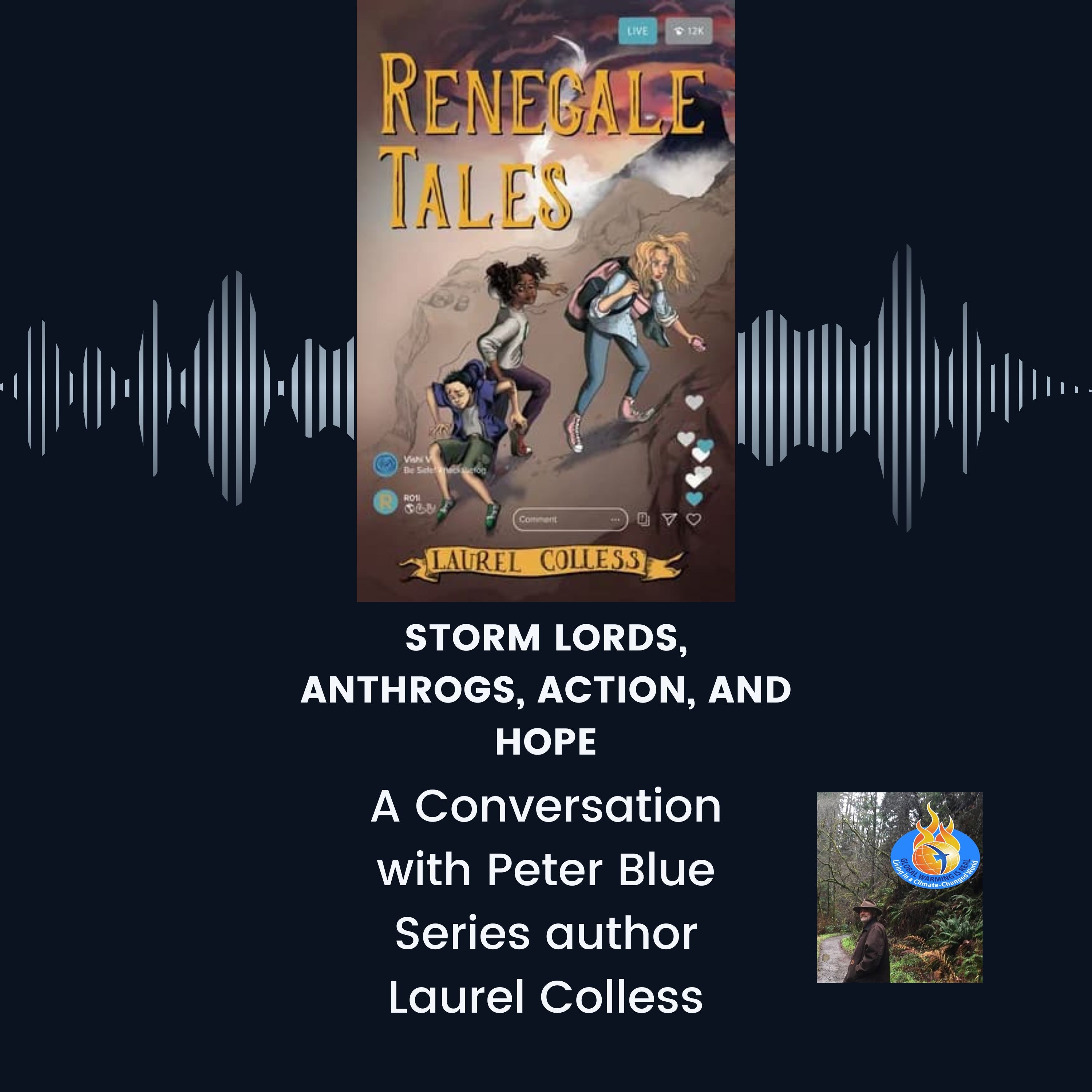


Anthrogs, Action, and Hope: A Conversation with Peter Blue Series Author Laurel Colless


Vanquish the Storm Lords and Anthrogs!
The power of stories to shape our understanding of the world is a central theme explored in this episode. We welcome Laurel Colless, an author dedicated to igniting the imaginations of young readers through her Peter Blue series of fantasy-adventure novels.
By infusing her narratives with real-world environmental issues, Laurel not only entertains but also educates, allowing children and adolescents to confront the complexities of climate change. Our discussion explores how Peter Blue and his friends confront ecological challenges, transforming fear into hope and agency through teamwork and imaginative problem-solving.
Our discussion navigates the challenges of communicating urgent topics to a younger audience without overwhelming them. Laurel shares her insights on how fantasy can be a vehicle for addressing serious issues, transforming fear into empowerment. We also touch on the significance of humor and hope in storytelling, emphasizing that these elements can provide a necessary balance in discussions about climate anxiety. As we follow Laurel’s journey from corporate sustainability to children’s literature, listeners gain insight into the transformative potential of narratives.
This episode is a celebration of creativity and a testament to the importance of fostering a hopeful vision for the future, reminding us all that through storytelling, we can inspire change and resilience.
Takeaways:
- We are a storytelling species. The most powerful technology throughout human history is storytelling, shaping civilizations and beliefs.
- As myth-makers and storytellers, we use stories to navigate our understanding of the universe and our place within it.
- Children's literature can be a force for good, addressing climate change through engaging narratives.
- Creating a compelling narrative around climate action is crucial for inspiring a global response to the crisis.
Links referenced in this episode:
00:00 - Untitled
00:20 - The Power of Storytelling
03:19 - The Power of Storytelling in Climate Action
12:51 - Understanding Eco Anxiety in Children
24:27 - Introducing the School Series: The Ecodemic
28:25 - The Intersection of Technology and Nature in Storytelling
36:54 - The Journey of Environmental Awareness
40:57 - Humor and Hope in Children’s Literature
Of all the great technologies that shaped humanity, the most enduring, the one that arguably has most shaped the human endeavor, is the story.
Speaker AWe are a species of myth makers and storytellers.
Speaker AEntire civilizations, systems of belief and worldviews are imagined, built and maintained on a foundation of stories and myths, the great ark of human understanding.
Speaker AFrom our distant relatives huddled around primordial fire, seeking warmth and light and protection, to the images dancing in the glare of our screens, we define the world and our place in it by the stories we tell and the myths we employ.
Speaker AScience and mathematics help us quantify immutable laws.
Speaker AStories stand in the yawning cosmic chasm where time and space converge, helping us to understand what it means to be human in a dangerous, mysterious universe.
Speaker AThe themes endure, cautioning us against hubris, inspiring reverence for the forces of nature, and imparting a sense of wonder in imagining other worlds.
Speaker AThe story of humanity is just that, the story of the many challenges that climate change presents.
Speaker AForging a narrative that at once speaks to the enormity of the problem while maintaining a sense of hope and agency is, I suggest, the most daunting.
Speaker AWe have the science well on hand regarding the impact of anthropogenic climate change.
Speaker AWe have the tools to mitigate it, but we are failing to create a narrative that can bring a global population together to fight a common and existential predicament.
Speaker AStorytelling is an essential tool of understanding for all people and all generations.
Speaker AYounger readers, with their vivid imaginations unsullied by the vagaries of adult admonitions and calcified worldviews, are open to fantastical worlds and how things can be instead of how they are now.
Speaker ANurturing this fertile ground of imagination is a means of empowerment, allowing the coming generations growing into a climate changed world to cope, adapt, evolve and thrive in a world they will create out of the ashes of the burning world they inherit.
Speaker AOne of the things I like most about producing this podcast is learning about the journeys of the people I talk with the concentric lines of intent, circumstance and fate that lead them to do what they do.
Speaker AAnd today my guest is Laurel Colis.
Speaker ALaurel is an Australian New Zealander, children's author and creator of the Peter Blue series of fantasy adventure novels aimed at preteen readers.
Speaker AThe series blends mythic elements and fantastical adventure with real world environmental issues, leveraging compelling narrative to teach science and environmental concepts.
Speaker AKolla studied comparative literature and Greek mythology at university.
Speaker AHer literary training didn't lead directly to writing novels, but instead to a 25 year career in sustainability in the corporate world throughout Asia, the United States and Europe with companies like Mitsubishi and Nokia.
Speaker AHowever, her time in the corporate world left her frustrated with, as she puts it, the lack of progress in the grown up world.
Speaker ASo much potential to do something and so little being done.
Speaker AIn 2013, while living in Greece with her diplomat husband, Laurel attended an Al Gore climate reality leadership training.
Speaker AIt was in Istanbul during the Gezi park protest in Taskum Square, but I'll let Laurel tell that story nonetheless.
Speaker AThe experience inspired her to do whatever she could to shape a better future for her two daughters and their generation.
Speaker AShe returned to her love of mythic literature and set out to create Peter Blue, transforming the great stories of gods, monsters, mortals and heroes into a new kind of myth.
Speaker AShe arms her characters with courage, confident in the knowledge that together they have all they need to vanquish the Stormlords.
Speaker AThe series incorporates global environmental threats as central conflicts.
Speaker AThe villainous enthrogs, demons born from garbage dumps, represent environmental destruction while Peter and his friends model teamwork and creative problem solving.
Speaker AThe books are acclaimed for their skillful balance of adventure, humor and science education.
Speaker AAs of this recording, the Peter Blue series currently has three titles.
Speaker AEye of the Stormlord introduces eco fantasy themes in Peter's adventures and challenges in combating climate threats.
Speaker AIn Renegale Tales, Peter and his friends are sent to catch Renegale imps and contend with a toxic yellow fog that leads them to discover deeper secrets and danger.
Speaker AThe plot brings the characters into direct confrontation with environmental disasters.
Speaker AKnights Unite focuses on children advocates at an environmentalist school who must balance their developing ideals with real world challenges.
Speaker AThe book has been described as a fast paced science fantasy Hogwarts with climate action.
Speaker AListen in as Laurel expands on her work, philosophy and life story.
Speaker ALike the young readers of her novels, you'll come away inspired and engaged, imagining a world free of anthrogs and Stormlords.
Speaker ALet's go.
Speaker BHello Laura Colis, Nice to meet you and thank you for being on our podcast.
Speaker CThank you.
Speaker CHi.
Speaker CHi.
Speaker BTom Laurel is the author of the Peter Blue series of books for young adults.
Speaker BWhat is the age range that you're targeting?
Speaker CActually I've been targeting 9 to 12 year olds but I recently got recognition from the US Green Book Award where they placed it as a young adult book.
Speaker CSo at Delta Penn I'm thinking upper middle grade to 13 or 14 year olds and also co reading because I think there's a lot in there also for adults or parents or caregivers to co read.
Speaker BI would think so so in the Peter Blue series, you're blending magical realism with these urgent environmental themes.
Speaker BSo what inspired you to use that fantasy as a vehicle for communicating climate change to these young readers?
Speaker BAnd how do you balance the magic with realism in your storytelling?
Speaker COkay, that's a really good question.
Speaker CI appreciate that question because I did put quite a bit of thought into it.
Speaker CAnd, you know, I've been doing this for more than 10 years now, but when I first started pulling together stories and ideas for this series of novels, I was asking myself, you know, how am I going to do this?
Speaker CBecause I had decided already I wanted a new kind of mythology or storytelling that would somehow raise awareness of the climate crisis.
Speaker CSo that was my mission.
Speaker CBut of course, I understand perfectly that for 9 to 13 year olds having an environmental mission and writing a kid's sort of thriller, I mean, it's quite hard to marry those two ideas.
Speaker CAnd if a kid gets a whiff from their parents that this isn't educational or environmental, they're going to go as far away from your book as they can.
Speaker CSo I had to think.
Speaker CI knew climate change was gonna be my big villain, but how do you represent that in a way which is compelling, entertaining, fun, not too scary?
Speaker CSo kids could still be a little bit scared, but in the safety of their pajamas in the bedroom.
Speaker CStorytimes, I did the masterclass which Salman Rushdie has, and it was such a.
Speaker CIt was so perfect for me because he has, he's the true master of having these fantasy overlays with a kind of realism or realistic backdrop.
Speaker CAnd I hesitate to use the term magical realism because I feel like that's somehow owned by the Latin Americans, the Gabriel Garcia Marquez and others who really made that their own.
Speaker CBut I did want to have this idea that I wouldn't be world building, so I'm not making some kind of world that's over there that my child readers would get a free pass and feel like, oh, this is a problem that belongs over there.
Speaker CNothing to do with me.
Speaker CNo, I wanted today's realistic problems, but I wanted to enter it through the imagination, I guess, to so take it through the imagination.
Speaker CSo I'm telling you too much.
Speaker CI guess the main point is I created monsters.
Speaker CSo I went out and created monsters.
Speaker CWe're the monsters.
Speaker CAnd I was living in Greece at the time.
Speaker CI'm married to a diplomat, so I'm now living in Helsinki, by the way.
Speaker CSo we're in slightly different time zones.
Speaker CBut I decided that when I was living in Greece and I started delving into Greek mythology, which I studied at university.
Speaker CAnd I thought, what I'm going to do is create something, a new kind of myth that would be more relevant for today's children and could start to draw children in with these monsters.
Speaker CSo I needed a name for the monsters and I took a Greek word which I had just learned.
Speaker CI'd only.
Speaker CI've been living there a few months and the word for mankind or humanity is anthropos, which is, you know, we all know.
Speaker CWe.
Speaker CWe know that actually we know it from anthropogenic climate change.
Speaker CThat's right, anthropology.
Speaker CSo the word for humankind, I took that stem.
Speaker CAnthrop.
Speaker CAnthropop.
Speaker CAnthral.
Speaker CAnd I put it together with the English word hog.
Speaker CThat's no offense to pigs.
Speaker CI always say when I tell the story, I'm.
Speaker CBecause animals do not take more than their share, generally when they're in the wild, whereas humans do.
Speaker CSo the idea of overconsumption and human.
Speaker CNot greed, but just taking more than we need because it's there and, and putting that into the context of landfill and trash and marine litter and pollution and all the garbage that goes with overconsumpt and creating these monsters that are birthed out of pollution and basically they're birthed out of garbage or they are nature spirits in this kind of.
Speaker CAs far as people can suspend their disbelief.
Speaker CI mean, a lot of people do talk to nature spirits and believe in nature spirits, but nature spirits that have been turned by pollution, showing up as weather monsters, showing up as very dangerous killer storms, wildfires, floods, you know, you know the drill.
Speaker CI mean, this is.
Speaker CRight.
Speaker BYeah.
Speaker CI feel like I've.
Speaker CI've managed to get some success with this because in the book which I've just released, which just got this recognition as actually.
Speaker CBut this night to unite.
Speaker CSo this book has a sea monster, a sea beast, and it has, I guess you could say if you're looking into mythology, indigenous biblical or Greek mythology, you could say that it has the look of a leviathan, if you've read your Old Testament.
Speaker CBut it's also got the behavior of some of these monsters that showed up when Odysseus was the sailors.
Speaker CIn the great epic, Homeric epic, Odysseus runs across.
Speaker CI'm pretty sure he runs across these two quite famous sea monsters, Scylla and Cherubnus, who.
Speaker CI think that's where the term rock and a hard place came from, because you've got to go through a narrow state and you have these two monsters, they suck seawater up and then they vomit it back onto the boat and then they create a whirlpool.
Speaker CSo that's what this is doing.
Speaker CExcept in my case, it's sucking up garbage, seawater and vomiting that back into pool assembly.
Speaker CSo I don't know.
Speaker COnce I start talking about this, I start to talk without stopping saying, you better.
Speaker BIt's all very interesting.
Speaker BYeah.
Speaker BSo you take on these complex issues, pollution, biodiversity, all the climate related disasters, and there's this tension between these monsters that you're creating and your characters that are dealing with it.
Speaker BHow do you approach these topics without overwhelming your readers?
Speaker BAnd how do you deal with the idea of eco anxiety that young people must be feeling?
Speaker COkay, well, ego anxiety is definitely a real thing and it's something we're talking more and more about.
Speaker CChildren are actually being diagnosed and it can be quite serious.
Speaker CFor the purpose of this conversation, you know, I'm not a, I'm not a psychiatrist.
Speaker CAnd when I'm talking about it, I'm talking more in the sense of you're feeling glum.
Speaker CThis is also a really, it's, it's really, it's real.
Speaker CAnd I have two daughters.
Speaker CThey were actually 9 and 12 when I started this project and they're now graduating.
Speaker CMy daughter graduated on Saturday.
Speaker CBut they had a lot of anxiety when I started working with the eco clubs.
Speaker CAnd of course I made them come in and be part of my group teaching children as a volunteer.
Speaker CWhen I lived in Greece, which was the first time in my life when I couldn't actually work, I didn't speak Greek, so I started volunteering, which is where this grew up from.
Speaker CBut eco anxiety comes for, particularly in children when they go out and they learn something, for example, at school or they read something or they see it on TikTok and then they go home.
Speaker CSo they learn about the climate crisis and they're like, this is urgent.
Speaker CAnd then they go home and they see what their parents are doing or not doing, or their leaders in their community or political leaders or in their church.
Speaker CThey see that.
Speaker CIt's like I still remember Greta Turnberry at the UN saying, nobody's doing anything.
Speaker BRight.
Speaker BI remember that.
Speaker CAnd this is how kids sometimes feel.
Speaker COr they have the opposite and they feel like, this is so hopeless, there's nothing we can do.
Speaker CSo, you know, the other side.
Speaker CSo what I've tried to do with the book and I've been really mindful of this is.
Speaker CAnd what I also tried to do in the environmental clubs was kid led action.
Speaker CSo, you know, take action.
Speaker CAnd I Called the clubs, the Carbon Buses Club, just because I like to have the word carbon, which is quite scientific, and there's obviously something very relevant here, but tricky.
Speaker CI added the word bust.
Speaker CCarbon busting, as in reducing your climate footprint, looking for clever ways, or talking about, of course, we have all the other harmful greenhouse gases and other problems.
Speaker CBut I wanted this idea of busting because it sounds a bit like, bust a move, like, do something, let's get going.
Speaker CAnd that's exactly what kids need to pull them out of this.
Speaker CBecause, you know, I do also worry sometimes that maybe I told my own children too much, because I can remember one of my daughters crying for some nights about deforestation.
Speaker CAnd they had been shown pictures of football fields, and then they'd been told every 10 minutes in the Amazon, this many football fields is going down.
Speaker CAnd I remember vividly some years ago when we moved back to Helsinki, where I am now talking to a group of parents in a rather informal presentation on an environmental day.
Speaker CAnd one of the dads in the audience when I was showing some of the things I was doing, he stood up at question time and said, do you really think we should be giving this much information to our kids?
Speaker CAnd I, honestly, I was a little bit taken aback.
Speaker CAnd maybe it was my bad, because I just presumed, of course, we need to tell them because they're going to inherit this mess.
Speaker CWe need to keep going.
Speaker CBut I wonder if I was being a little selfish, because with my own children, I still don't tell them about Santa Claus or the Easter Bunny.
Speaker CI'm keeping the magic alive, and they're 18 and 21.
Speaker CI like the idea of magic, but I also like the idea of.
Speaker BYeah, magic can be a vehicle to communicate realism.
Speaker CI was hoping you said that, because the way Salman Rushdie put it is he said, there's so many ways to tell the truth, and sometimes using fantasy, it can be actually a more powerful way with children to sort of get in at the problem and make it feel somehow palatable and manageable, digestible in a way.
Speaker CYeah.
Speaker BCommunicating climate change for anybody, for any age group, in my experience, that is the challenge.
Speaker BHow do you talk to people about climate change now in the adult world?
Speaker BYou have maybe a different set of issues.
Speaker BAt least here where I am in the United States, you're.
Speaker BYou're fighting information.
Speaker CYeah.
Speaker BMisinformation.
Speaker BDo you address that in.
Speaker CYeah, I have a character in this current book.
Speaker CHe's actually the owner of the yacht that goes down.
Speaker CAnd I love him, Mr. Dean.
Speaker CHe's an 80 year old billionaire from Australia and he's a sort of, well, I shouldn't name names, but you can imagine the kind of people I have built his character around.
Speaker CBut he's also very loving and he's got a big, big heart and he loves my main protagonist, Peter Blue.
Speaker CBut he is an anthrog denier and all the kids are like, he's an anthrog denier.
Speaker CAnd they've actually been out in book one and they've been fighting anthrogs, these huge storm lords.
Speaker CAnd then he's like nah, it's just a bunch of lies made up by governments to take away more of my.
Speaker CAnd they're like no.
Speaker CAnd so he says well show me one of these anthrog thingies and I'll see.
Speaker CAnd sure enough in the middle of the book he meets the sea beast.
Speaker BAnd I don't set the kid, he's.
Speaker CConverted and then he's converted and he starts using his money and his agency to get things done.
Speaker CSo that's the best kind of denouement in my opinion.
Speaker BYeah, we'd hope we can find some of those folks in real life.
Speaker CYeah, exactly.
Speaker CBut to your point about adults talking to adults, I'm more and more thinking that we should just steer away from even using the word climate crisis because that's an opportunity.
Speaker CI mean addressing fossil fuel and addressing pollution, it's just an opportunity to co create a better world, to co create a world, a healthier, cleaner world.
Speaker CIt just for me is such a no brainer and I was lucky enough, I was just gonna say I, it just came to my mind that I went to see the chairman of the IPCC who came to Helsinki a few weeks ago and one of the things that he showed, I mean it's all pretty dire news.
Speaker CHe had a long PowerPoint presentation with all the numbers and we're not close to our Paris targets, but you know all this.
Speaker CBut one of the things he pulled up a slide and the slide was called co benefits and he was drawing attention to the things that we can do that not only address these numbers but have extraordinary other benefits to society for job creation, wealth creation.
Speaker CBecause of course solving the climate crisis is also about bringing everyone along, not just right.
Speaker BI, I agree with you.
Speaker BI've had people ask me a lot how I communicate, how do I try to communicate climate change.
Speaker BAnd, and I've decided if it's possible to not even mention the word climate or climate crisis, especially steering around it, especially here in the United States.
Speaker BYou mentioned that and, and you're off you.
Speaker CNo, there's so much baggage with the, with.
Speaker BYeah, it's just baggage.
Speaker CAnd also people are fearful because, you know, so the government's gonna take away my car or stop me from eating my beef or the government wants to do this or that, you know, and I won't be able to.
Speaker CWell, for example, I have firsthand experience in the grown up world living in Washington D.C. back in 2006, 2007, so I don't know, it's going back a fair wage.
Speaker CI did one of the most, I would say one of the most exciting and biggest projects of my life.
Speaker CIn my former career, before I became a children's writer, I was working in Virginia Tech and they gave me carte blanche to.
Speaker CAnd I came from Europe and I had all these big ideas about what the Europeans were doing.
Speaker CAnd I'd been working at Nokia, which, you know, was a global success story at the time.
Speaker CAt the time.
Speaker CAnd I said, why don't we do this kind of Bill Clinton style energy efficiency program where we bring building owners in and we take all the low hanging fruit for addressing the climate crisis, which is basically energy efficiency in big old building stock, decent sized buildings, 10 to 20 floors, and you'll be able to retrofit them using Virginia Tech technologies.
Speaker CWe bring in the professors, we have these multi stakeholder discussions, we bring in the building owners, we bring in the federal government, and we bring in like Arlington county and other local governments and we make this big project and raise awareness on how you can win, win, win.
Speaker CIf you retrofit your building, you can basically within seven years, according to the way we set this up, you could within seven years have amortized all the loans for your upfront expenses through energy savings.
Speaker CYeah, it's a perfect equation.
Speaker CAnd I was so excited to be pitching it.
Speaker CI was kind of in the middle of bringing together the partners, talking about all the technologies and trying to bring everyone in.
Speaker CAnd then we got a lot of pledges.
Speaker CI mean, this is quite an old story now.
Speaker CI think it was 2008 when we launched and we did actually get front page of the Washington Post.
Speaker CIt was a big story.
Speaker CThat's good.
Speaker CAll these developers were coming to the press conference and when you have that big money came to the press conference and Washington, Virginia Tech was happy because they're a Blacksburg school a little bit out and they wanted to get more of a presence in the national capital region, where they did actually have a campus in Alexandria.
Speaker CAnd I stayed with that for five years and a lot of the building owners who pledged.
Speaker CSo we said, let's try to get a hundred buildings and we'll have all this avoided carbon emissions numbers that we can throw at the media and it'll be so great.
Speaker CAnd how many people do you think really finally went ahead rent trip?
Speaker BI'm afraid to ask.
Speaker CYeah, I mean it was really, really slow.
Speaker CAnd then people kept saying, I mean, of course there were legitimate concerns as well, but people were saying if I want to flip my building, you know, I'm in it for the profit, then I sell forward the loan.
Speaker CIt's complicated.
Speaker CAnd there were so few uses.
Speaker CAnd then of course, we did have.
Speaker CI shouldn't.
Speaker CThe recession, the recession which came.
Speaker CBut at the same time, you know, there were lots of pledges of a big amount of energy efficiency investment dollars.
Speaker CI wasn't planning to talk to you about this, but as a memory, it was an example of how grown ups sometimes feel compelled to and sometimes really are compelled to put short term financial gains ahead of long term.
Speaker CSensible decision making.
Speaker CYeah, and I'm sympathetic to that too.
Speaker CIt's not easy for parents also to always be able to.
Speaker CSometimes these things come at a premium.
Speaker BRight.
Speaker BDo you address short termism or long term those issues in any way in the books?
Speaker CI'm thinking because it's top of mind.
Speaker CBut these are still like kids adventure stories.
Speaker CBut you know, the grownups are usually one step behind in these books.
Speaker CSo the book is a school series.
Speaker CIf I can jump back to the books.
Speaker CSo what you would call sort of ensemble literature where you have a big group.
Speaker CPeter Blue is my protagonist and he sort of modeled.
Speaker CI'll be very open.
Speaker CHe is modeled around the boy Arthur.
Speaker CI feel like that's the only big story and Harry Potter around it as well.
Speaker CBut I didn't model it around Harry Potter.
Speaker CI modeled around T.H.
Speaker Cwhite's original beautiful novel from 1932 called the Once and Future King, which is a lovely piece of literature that follows the whole story of Arthur, King Arthur.
Speaker CBut of course we're most fascinated by the lovely time at the beginning when he's with Merlin.
Speaker CAnd I do have a Merlin type character who's the forest mentor at the school.
Speaker CSo it's a school series and the kids come from everywhere.
Speaker CAnd it's the top ecodemic, we call it.
Speaker CSo the top ecodemic kids from all around the world.
Speaker CSo everyone's speaking English, but no real culture or language is highlighted.
Speaker CIt's just the culture of the school, which is to take the intelligence from every possible source so it's high tech, but it's also nature intelligence.
Speaker CAnd the school is what makes it.
Speaker CWhat gives me some depth in the storytelling is that the school is run by a larger organization, a grown up organization called Gaia intended, but that's an acronym, the Global Advanced Intelligence Agency.
Speaker CAnd there's an element of the Pentagon sort of Hogwarts.
Speaker CThere's a whole bit.
Speaker CYou have real grownups who are trying to do all this stuff and they're sharing a lot.
Speaker CI mean they have these very advanced anthrog warfare technology devices and helicopters called goshawks, but they also talk to frogs and they're always telling the children that nature has so much to tell us if we'd only just get better at listening.
Speaker CSo I very much have brought that together that you have all of the intelligence, the intelligence is available to be tapped into and that's the environment that the children are in, which I love.
Speaker CAnd of course they all have different strengths.
Speaker CSo one of the side characters who now is getting her own book, she is able to communicate with nature spirits.
Speaker CShe's always been able to.
Speaker CAnd some of the others scoff at this.
Speaker CSo I always have two sides and the others can't see what she's seeing.
Speaker CSo you know, so it sounds like.
Speaker BYou'Re addressing perhaps how we relate to nature, our relationship with nature.
Speaker BIs there a juxtaposition between technology and nature in your books?
Speaker CI hope there is because that's what I set out to do.
Speaker CFor example, in book two, Rendegal Tales, which is centered around these massive winds attacking winds, Renegales Wanda is the main character who comes forward in that book and she is very high tech with her gadgetry and her phones and she is big, she's got very ambitious.
Speaker CShe's actually sorry to say, but she's big voice, big everything and she's American.
Speaker CBut she's brilliant and she signs up for everything and she charges forward.
Speaker CShe does it partly because she wants to be best and to be first, but she also does it because she's big hearted and got a big vision and she uses her phone in a way that is of course building up her social media complex, but she also solves a massive natural disaster problem where they have to actually work with nature intelligence.
Speaker CAnd she finds a way to use her phone to do that.
Speaker CI don't want to be a spoiler and it's too hard to explain going, but I really wanted.
Speaker CSo no one's ever asked me that.
Speaker CSo.
Speaker CSo that is actually a real example where it's not just about cold technology, but we want to use everything that we're empowered with.
Speaker CFor example, Peter has a jacket.
Speaker CSo all the Gaia agents who are like these top global intelligent people, men and women, they wear Gaia jackets, which are wearable devices, very intelligent wearable devices.
Speaker CAnd Peter has one that he inherited from his dad.
Speaker CBut Peter, my main character, he's much more like me.
Speaker CHe's kind of a flake, not very good with technology.
Speaker CHe's got a wonderful big heart and he's like typo blood.
Speaker CHe goes with everything.
Speaker CBut his dad is a big adventurer who gets into a lot of trouble.
Speaker CAnd he had inherited his dad's jacket, but he doesn't really know how to use it.
Speaker CBut luckily his best friend Roly knows everything because his best friend Roly's dad works for Gaia and he mends these Gaia jackets so he knows everything about how stuff works.
Speaker CAnd then Peter, when he learns how to use the guy jacket, he invariably gets it wrong.
Speaker CAnd then the guy jacket becomes sort of something more because Peter has a lot of light and I don't want to go too deep and.
Speaker BOkay, okay, yeah.
Speaker BSo you're meeting the generation where they are technologically the phone.
Speaker BAnd these are things that are just.
Speaker BThey grew up with.
Speaker BIt's part of their.
Speaker CAnd I'm saying DNA, you know, I have to remember I was an old mum, so while I was writing these stories, my kids were growing up because I was late with my children.
Speaker CSo I was quite lucky that way because, for example, I was writing a scene this morning where I had Chu, who's actually one of my favorite characters.
Speaker CHe's very rational, and he pulled out a piece of paper to show his plan.
Speaker CAnd I realized after I'd written that of course he wouldn't pull out a piece of paper, he would just hear the whole thing, like on old papers, writing.
Speaker CYeah, exactly.
Speaker BYeah.
Speaker CSo things like that, to your point?
Speaker BYeah, yeah.
Speaker BSo are there four books published right now?
Speaker CNo, I.
Speaker CWell, there's this one origin story that I wrote first in 2016.
Speaker CPeter grew up at an old folks home because his dad was out adventuring and getting lost.
Speaker CSo it's kind of Peter's story of how he got to Spiral hall, which is the school where the action takes place.
Speaker CAnd that's the kind of foundational story that maybe I think kids who really get to love Peter might want to go back to.
Speaker CBut at the moment, I'm thinking of these three which are published Eye of the Stormlord, Renegale Tales and Knights unite.
Speaker CThey're thrillers.
Speaker CThey're many thrillers.
Speaker CIt's like Hardy Boys meets Harry Potter meets the Famous Five.
Speaker CSo you have these ensemble groups solving big problems and getting all kinds of problems.
Speaker CBig tree.
Speaker BThat's an important point too, I think, is communicating to young people that they address these huge, complex, seemingly overwhelming issues.
Speaker CExactly, yeah.
Speaker CAnd that they have to, because usually they're quite reluctant, but I leave them with no choice.
Speaker CSo it's like you put them up a tree and throw rocks at them.
Speaker CWho said that?
Speaker CAnd then bring them down so that, you know, I'm putting them into these fixes.
Speaker CAnd also, I really want to make the point that it takes teamwork, usually to get out of it, which is how we're going to have to work together on the real life crisis.
Speaker CAs I got deeper into the storytelling and looking at mythology, I noticed something which I'd like to share with you because it's been weighing on.
Speaker CIf you look at the mythology, at least in the Anglo Saxon tradition, we look a lot at Greek myths.
Speaker CThis is a classic example.
Speaker CYou take the story of the Minotaur in Crete, the Cretan Minotaur and the story of Theseus.
Speaker CThat problem was something that the adults in that city had created.
Speaker CI mean, it was to do with your old problems created by people from the past.
Speaker CAnd then who gets to go into the labyrinth?
Speaker CThe virgins or the eight children?
Speaker CI can't remember.
Speaker CYou know, it depends on the seven boys and seven girls have to go in and suffer the consequences every year.
Speaker CSo finally Itheus, who had nothing to do with the problem from the outset, has to come in and fight the Minotaur to finish things off finally.
Speaker CAnd luckily he has Ariadne with her golden string to use her savvy and her smart to help him.
Speaker CSo there's a lot of stories like that, also biblical stories where the town behaved badly and not listen to the gods, and then it's invariably the young people that have to come in.
Speaker CSo you.
Speaker CThe script here.
Speaker BSo were you always a writer?
Speaker BWere you always an author?
Speaker CNo, no.
Speaker BWhat did you do before you wrote these books?
Speaker CWhat I did was I studied literature at university and thought that that's where I was going to head.
Speaker CAnd so I graduated as a literary comparatist and I did my thesis on medieval poetry and I was like going deep into Gawain and the Green Knight and these kinds of things and looking at imagery and looking at this ancient storytelling.
Speaker CSo it was already there, somehow simmering below the surface.
Speaker CBut I Grew up in New Zealand, which for people who don't know, it's way.
Speaker CIt's even below Australia at the bottom of the world.
Speaker CSo as soon as I.
Speaker CThe day I graduated, I actually flew to Italy and I started building a life in the Northern hemisphere because I felt like I wanted to see what was going on.
Speaker CAnd before long I ended up in Japan.
Speaker CSo I'm really showing my age now because at that time when I went to Japan, kids in primary school in New Zealand were studying Japanese.
Speaker CAnd now those same kids will be studying Chinese, I'm sure, who want you looking at Asian languages.
Speaker CBut then it was a Japan boom and I ended up joining Mitsubishi and becoming a corporate person.
Speaker CMet my Finnish husband in Tokyo and he took me way north, as far north as you can go, really coming if you start south in New Zealand.
Speaker CAnd I ended up working for Nokia for some years during the boom.
Speaker CAnd that was really like going back to university and studying business because it was a really successful company and there was a global matrices I was working in and I learned so much.
Speaker CAnd then ended up at Virginia Tech when my husband became the Finnish ambassador to US and had a six year tenure there during Obama's first term and George W. Bush's second term.
Speaker CAnd so that's when I had the Virginia Tech stuff.
Speaker CAnd that's when I also made this pivot because I just got so disheartened by the lack of progress in the grownup world and started.
Speaker CMy husband got a posting in Greece sort of on the way home to Finland, and we got there right as the economy imploded.
Speaker C2012 or 13, I'm trying to remember.
Speaker CThere was no account of me having a job or doing anything other than this volunteering, which was in a way a gift, when I look back, a gift to me because I started the books then and started working with the upcoming generation.
Speaker BYeah, and you did the Al Gore climate reality.
Speaker CYeah, I did that from.
Speaker CActually, yeah, in Greece.
Speaker CBut no, I did.
Speaker CI went from Greece and did it in Turkey.
Speaker CYou've also done.
Speaker BI did.
Speaker BIt was in San Francisco.
Speaker COkay, lovely.
Speaker CHow long ago?
Speaker BIn.
Speaker BI think 2012, I believe it was.
Speaker COkay, so you before me.
Speaker CI did it in 20.
Speaker C2013, I think.
Speaker CYeah.
Speaker CSo just talk to you.
Speaker COkay, but I think I probably have a better story than you because I went to Turkey alone and Gore had decided to do it in the.
Speaker CI don't remember the hotel, but it was an American hotel, but he did it right on Taksim Square, right when the uprising that weekend occurred.
Speaker CThe famous one.
Speaker BWow.
Speaker CIt was actually relevant because it was young people trying to save a park.
Speaker CSo it was beautifully relevant.
Speaker CI had booked my hotel on that Taksim Square, just a little hotel, and I couldn't get back to it.
Speaker CI was out all night with tear gas sitting in the gutter.
Speaker BWow.
Speaker BYeah.
Speaker BYou have a better story than I do, for sure.
Speaker CBut at that time.
Speaker CIt's changed now.
Speaker CBut Al Gore invited everyone to make their own heroic goal to go with the training.
Speaker CAnd so I chose the books and working on this project as my goal.
Speaker BOkay, so the Al Gore training was the inspiration to do the books.
Speaker BInteresting.
Speaker BThat's interesting.
Speaker BOkay.
Speaker BI think it's very important what you're doing because we adults are leaving the younger generation with existential crisis, unfortunately.
Speaker BAnd any way that you can communicate that.
Speaker BWhat sort of feedback have you been getting from your book series?
Speaker COh, well, people are praising them.
Speaker CSo I've got two types of audiences.
Speaker CMy issue is that I have to always be pitching to adults to try to persuade them to buy the book so that they would then give it to the children to read.
Speaker CIt's quite hard to market directly to children.
Speaker CSo I'm of course going on two prongs.
Speaker CI'm going down the literary avenues and also down the environmental, talking to people like Jane Goodall and people who might want to give me an endorsement, but also going for Editorial reviews.
Speaker CAnd actually I was really pleased with my most recent Kirkus Review, which described the whole series as.
Speaker CLet me just get this right.
Speaker CCommerce has created a kind of Hogwarts that operates on the magic of environmental awareness.
Speaker CAnd I thought that was like music to my ears.
Speaker CBecause if someone's going to compare it with Harry Potter, one of the most successful theories we've ever seen in middle grade, I'm happy.
Speaker CBut the problem is it's so hard to market and get.
Speaker CI'm still going for critical mass.
Speaker CI'm selling the books all around the world in English speaking countries.
Speaker CBut kids, you know, kids don't talk about the environment.
Speaker CThey just talk about the storytelling and which character they like best.
Speaker CAnd.
Speaker CAnd that's good.
Speaker CHappy with.
Speaker BYeah, yeah.
Speaker BThat can plant the seed.
Speaker CYeah, that's what I'm hoping.
Speaker CAnd.
Speaker CAnd if it doesn't.
Speaker CIf it doesn't.
Speaker CThe other upside, where we were talking about CO benefits before, the other upside is if a kid reads my book just for the pure enjoyment, at least they're reading, right?
Speaker BAt least they're reading.
Speaker BExactly.
Speaker CBecause literacy numbers are about as bad as the climate numbers going in the other direction.
Speaker BYeah, yeah, I think.
Speaker BYeah, in both counts.
Speaker BThat's great.
Speaker BEncourage people to read, young people to read.
Speaker BThey get into the stories.
Speaker BIf they don't become great environmental champions, at least they might be readers.
Speaker CExactly.
Speaker BWhich makes them critical thinking and better in the world.
Speaker BCo benefits, like you say.
Speaker CYeah.
Speaker BWell, anything you'd like to tell my listeners before we wrap it up?
Speaker CWell, I'd love your listeners read the books.
Speaker CI mean, if you go actually on to get the ebook, it's quite low price because I really want parents maybe to download the Kindle, take a look, and then buying the paperback for their children.
Speaker CSo I've deliberately kept the ebook quite low.
Speaker CIf you go onto Amazon, I don't know if you're able to put any links in the show notes, but I will definitely.
Speaker CThat would be really great.
Speaker CAnd also to contact me and give me your ideas and tell me what you think, because it's quite a lonely business being an author and figure this out.
Speaker CBut the only way for me now is forward.
Speaker CI'm going to keep going.
Speaker CI've got at least three or four more books to write and then I don't know if I can spin this off also into journals or other educational materials, but leading with the storytelling.
Speaker BYeah, yeah.
Speaker BMaybe a movie someday.
Speaker COh, hi.
Speaker CYeah, sign me up.
Speaker CI would love that.
Speaker BGreat.
Speaker BWell, thanks a lot, Laurel.
Speaker BI appreciate the work you're doing and our conversation and all your links will be in the show notes.
Speaker BIt's great to see people that are addressing the issue in a, you know, as positive a way as possible and making it accessible because it's such a difficult topic, especially communicating this to young people.
Speaker BSo I think it's great that you're doing that.
Speaker CAnd actually, I think hope is something we didn't talk about, but we probably should.
Speaker BRight?
Speaker CBecause when it comes to working with children, the doom and gloom doesn't sell that well.
Speaker CLike it.
Speaker BI definitely agree.
Speaker BYeah.
Speaker BDoom and gloom.
Speaker CYeah.
Speaker BYeah.
Speaker BIt's.
Speaker CIt's lead hope and it's easy to.
Speaker BFall into that, but it doesn't help.
Speaker CYeah.
Speaker CAnd also humor.
Speaker CWe didn't talk about humor either, but.
Speaker BOh, humor.
Speaker CI mean, of course I'm not trying to write jokes, but I'm always mindful that I'm throwing these characters together and they're so flawed and they're so fun in their own right.
Speaker CSo just putting them together, great way to generate humor as well.
Speaker BHumor and hope.
Speaker AHumor and hope.
Speaker COn that note.
Speaker BWell, we'll leave it there.
Speaker CThanks, Tom.
Speaker CThanks so much.
Speaker BThank you.
Speaker CAnd let's keep in touch.
Speaker CSee?
Speaker BYeah, definitely.
Speaker CHats off to what you're doing.
Speaker CDon't give up.
Speaker BYeah, yeah.
Speaker BMaintain hope.
Speaker BYou know, that's all we can do.
Speaker BEither that or give up.
Speaker AAnd that's not.
Speaker CNo, we can't.
Speaker CIf we've got kids in our life, we can't do that.
Speaker CAnd there are so many different ways that you can look at where your agency is and how to address a problem.
Speaker CSo.
Speaker CAnd make it fun.
Speaker AMake it fun.
Speaker BAnd maintain hope.
Speaker BAnd maintain a sense of humor.
Speaker AIn addition to her writing, Laurel is the founder of the Carbon Busters Club, a kids climate science program that combines storytelling with science education.
Speaker AMy hat's off to Laurel Colas for focusing her talent and efforts on helping young people and their parents imagine a world where we vanquish weather monsters, stormlords and anthrogs.
Speaker ACheck the Show Notes for more information about Laurel and the Peter Blue series.
Speaker AAnd if you like what we do, please subscribe to the podcast if you're so inclined.
Speaker AYou can also donate a dollar or two for the cause with our profound gratitude.
Speaker AThanks for listening.
Speaker AWe'll see you next time on Global Warming Is Real.
Speaker AThere's always more we can do to stop climate change.
Speaker ANo amount of engagement is too little.
Speaker AAnd now more than ever, your involvement matters.
Speaker ATo learn more and do more, visit globalwarmingisreal.com thanks for listening.
Speaker AI'm your host, Tom Schueneman.
Speaker AWe'll see you next time on Global Warming Is Real.
Speaker CSa.