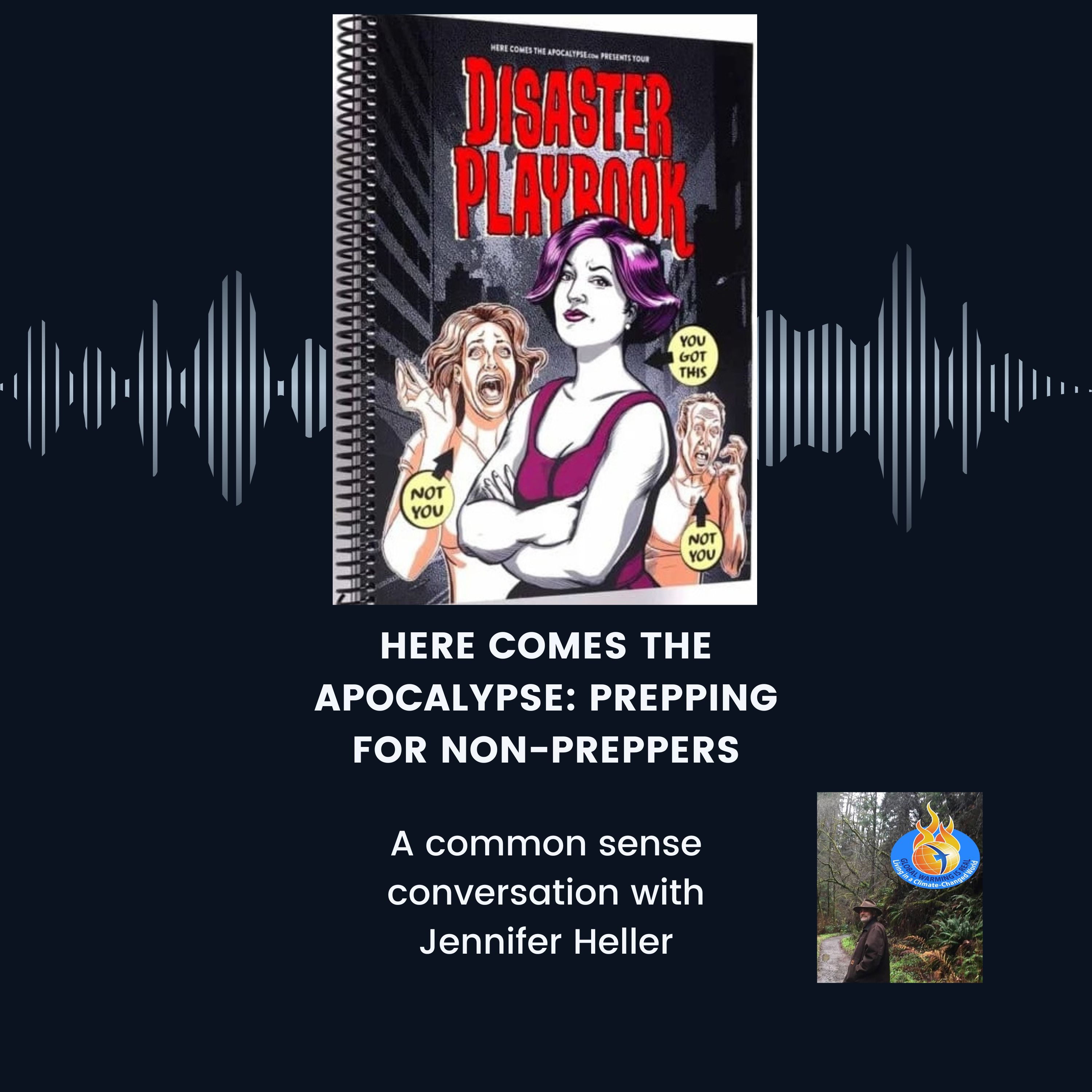


Here Comes the Apocalypse: Jennifer Heller's Guide to Disaster Preparation for Non-Preppers


Here Comes the Apocalypse! Panicked or Prepared?
The art of preparation in today's polycrisis, conspiracy-driven world is far from straightforward. In all cases, it is an art that encompasses, among other things, science-based common sense and community-oriented planning. Just as important is a sense of humor. With preparation, we can laugh in the face of the Apocalypse!
As we navigate the eerie and unsettling landscape of climate change and societal upheaval, the notion of being prepared has evolved into a complex tapestry of ideologies and practices.
Our guest, Jennifer Heller, the founder of Here Comes the Apocalypse, dives into this transformation, offering a refreshing perspective that strips away the theatrics often associated with disaster preparedness.
Heller’s approach is grounded in community spirit and practical solutions, advocating for an informed yet light-hearted method of preparing for the unexpected. Through her personal experiences, including the loss of two close relatives' homes in two separate California wildfires, she emphasizes the critical importance of having a structured disaster plan that is accessible, sensible, and grounded in reality.
Heller’s unique brand of humor shines throughout our chat, reminding us that while the topics at hand may often be grim, a dash of wit can make the daunting task of preparing for disaster a bit more palatable. Her program, Here Comes the Apocalypse, is not just about survival; it's about recovery and fostering a sense of community where preparedness is a shared responsibility.
We conclude our conversation by remembering that, amidst the chaos, we should not lose sight of the joy in our daily lives.
Humor and gratitude can keep us sane in crazy times.
Takeaways:
- In an uncertain world, being prepared is not just a motto but a necessity for survival, as the reality of disasters is increasingly undeniable.
- Humor can play a crucial role in disaster preparedness, helping to lighten the weight of serious topics while equipping ourselves for potential crises.
- Local community engagement and cooperation are essential; when disaster strikes, your neighbors may be your best resources for support and safety.
- The traditional prepper mentality can be daunting, but practical approaches to preparedness can empower individuals without succumbing to paranoia or extremism.
- Having physical copies of important documents is vital; during a disaster, relying solely on digital information can lead to unnecessary complications and stress.
- Fostering a sense of community resilience not only prepares us for disasters but also cultivates connections that can enrich our everyday lives.
Resources:
- Jennifer Heller
- Here Comes the Apocalypse
- FEMA Community Emergency Response Training
- GlobalWarmingIsReal
00:00 - Untitled
00:18 - The Evolution of Preparation
04:50 - Preparing for the Apocalypse: A New Approach
10:45 - The Importance of Preparedness
19:45 - The Importance of Preparedness in Uncertain Times
25:48 - The Importance of Community Resilience
37:51 - Preparing for the Future: Mental Health and Resilience
Be prepared.
Speaker AI remember well my Boy Scout motto, But am I?
Speaker AAm I prepared?
Speaker AWhatever it was I was preparing for as a young lad in the late 60s, it's different now, a fundamentally different world than it was half a century ago.
Speaker APreparation morphs into prepping and suddenly meanings change.
Speaker AA cultish ideology tinged with a militaristic flare from silly or impractical to serious, step by step instructions for the second coming.
Speaker ABut what if people just want to be prepared?
Speaker AWhat can actually keep people alive and safe in what is likely to happen in the real world?
Speaker AThat we live in an age when the real world is up for debate is unsettling.
Speaker ABut when the fire is licking the treetops down the road, the water is rising through the front door, or the coming wind sweeps aside houses like toys, preparation without BS is best.
Speaker AWhen we emerge from the ashes, we can resume our petty disputes then.
Speaker AAnd as uncomfortable as it is for everybody, there's something we all seem to agree on one way or another.
Speaker AThe apocalypse is coming.
Speaker AWhether through divine intervention or climate change, things could get bad.
Speaker AI don't remember that maintaining a sense of humor was emphasized while we Boy Scouts prepared for whatever, but it should have been.
Speaker AWhich leads us, in a roundabout sort of way, to Jennifer Heller.
Speaker AMy guest today on Global Warming is real.
Speaker AHeller is a content creator, entrepreneur and occasional blogger.
Speaker AHer entrepreneurship, community spirit, big heart and self professed dark sense of humor help us be prepared for what may befall us in the blood, flesh and feathers world we inhabit.
Speaker AHeller recently launched Here Comes the Apocalypse, her dark sense of humor evident in the title.
Speaker AIt's a self paced disaster preparedness system for non preppers like you and me.
Speaker ANo bs, no fluff, and some things that might surprise you from every angle.
Speaker AHeller's playbook is thoroughly researched.
Speaker AShe goes down the prepper rabbit hole so we don't have to.
Speaker AShe understands the genre, if you will, and extracts the practical, helpful information from the nonsense.
Speaker AHeller also participated in a FEMA sponsored Community Emergency Response Training, or CERT for short.
Speaker AShe was organized with her neighbors in the Bay Area town of San Leandro, recognizing that preparation is most effective when the burden is shared.
Speaker ABeyond the training and prepper rabbit hole, Heller has also lived it with two close family members losing their homes in two separate wildfires in California.
Speaker AShe incorporates her training, research and experience into a first responder recommended disaster preparation system that users can navigate at their own pace.
Speaker AThe process is admittedly tedious and come on now.
Speaker AShe tries to make it fun.
Speaker ABut let's get real.
Speaker AThis is going to Be tedious.
Speaker ABut at the other end emerges a customized exhaustive plan that will guide you through the disaster de jour.
Speaker AFire, flood, extreme weather, earthquake.
Speaker AAnd once the immediate danger has passed, your town is a smoking ruin.
Speaker AAnd you're trying to get through the day and maybe rebuild your life.
Speaker AWhat then?
Speaker AInformation is what then.
Speaker ADon't depend on the cloud.
Speaker AHaving all your essential information with you in hand is the start of the rebuilding process.
Speaker AIn the aftermath, as Heller says, the bureaucracy of life doesn't stop with the apocalypse.
Speaker AAnd I'd like to add, it probably only gets, well, more apocalyptic.
Speaker ASo what do we know?
Speaker ALet's sum it up in three points.
Speaker AShit happens oftentimes when we least expect it, perhaps mostly when we least expect it.
Speaker ASo it's best to plan for it.
Speaker AWhich leads me to my next point.
Speaker ARisk management is the only sane approach to disaster preparation.
Speaker AAnd it can only be accomplished before the aforementioned shit hits the proverbial fan, or real fan for that matter.
Speaker AOtherwise, it's not risk management, but neglect leading to a panicked reaction.
Speaker AAnd who needs more panic in this world?
Speaker AIn all cases, we must foster local flesh and blood community.
Speaker AGet outside.
Speaker AKnow your neighbor.
Speaker AThey're likely the ones you'll be around when the apocalypse comes calling, so.
Speaker AOh, I forgot one.
Speaker AFind joy.
Speaker AIt's out there.
Speaker AGratitude and humor keep us sane.
Speaker ABring it on.
Speaker AWe're ready.
Speaker AWe're prepared.
Speaker AAnd now, over to you, Jennifer Heller, founder of Here Comes the Apocalypse.
Speaker AJennifer Heller, welcome.
Speaker BHello.
Speaker BThank you for having me.
Speaker AYeah, it's great to have you.
Speaker AYou are the founder of Here Comes the Apocalypse?
Speaker BYes.
Speaker ASo why don't you tell us about what that's about?
Speaker BYeah, absolutely.
Speaker BSo I set out to prepare my family for disasters in 2017.
Speaker BI had my first child in 2016.
Speaker BAnd suddenly I cared a lot more about how we responded to disasters.
Speaker BIt also was the first year that here in the Bay Area we had smoky air so bad we couldn't go outside.
Speaker BAnd I had always thought, oh, global warming.
Speaker BI know it's happening.
Speaker BIt's going to be something my kids deal with.
Speaker BBut suddenly that year I realized, oh, no, this is something that I'm going to deal with in my lifetime.
Speaker BAnd so I was like, okay, well, we need a disaster plan, we need gear, we need to know what we're gonna do.
Speaker BAnd I found all of the resources out there.
Speaker BReally obscure, hard to understand, and super right wing crazy.
Speaker BLike, oh, here's my guns.
Speaker BI've got all the ammo.
Speaker BI've got a bunker full of food and all this stuff, and that's not me.
Speaker BI'm community oriented.
Speaker BA future where it's me and my family stuck in a basement for the rest of my life does not sound good.
Speaker BSo I was like, well, gosh, I can't be the only one trying to prepare my family and finding just these resources really hard to stomach and hard to use.
Speaker BAnd I've always been an entrepreneur.
Speaker BI have a design company, we do websites, marketing, that sort of thing.
Speaker BAnd I was like, you know, this is a fun niche, right?
Speaker BI mean, fun is such a fun niche, right?
Speaker BI've got kind of a dark sense of humor.
Speaker BSo I did find some humor in the topic.
Speaker BAnd since I had to understand it anyway, I thought, okay, well, let's turn it into something.
Speaker BAnd that was where I got the idea for Here Comes the Apocalypse.
Speaker BThe inspiration came from, like the last scene of Monty Python's Life of Brian where they're all nailed on the cross and they're singing, you gotta look on the bright side of death, you know, and like, how do we find the bright side in these dark times?
Speaker BAnd that's what I wanted to bring.
Speaker BA humorous but practical approach to disaster preparedness.
Speaker AThat's great that you bring a humorous aspect to this because obviously these aren't light topics and there's a lot of doom and gloomy, you know, just kind of, we're all going to die.
Speaker AI shared the experience, at least partly with you back in 2017 and 2018, 2019, 2020 in San Francisco.
Speaker AThe wildfires, I remember was in September of 2020.
Speaker AWaking up to the middle of the night, even though it was the day and the sky was orange.
Speaker AAnd you know, I've been writing about climate change and stuff.
Speaker AI, I, this is kind of my beat for a long time.
Speaker ABut something like that really opens your eyes and you go, well, this is getting close to home.
Speaker AHow did you go about so realizing you needed to do something, you wanted to have a, bring a sense of humor to it, and you found all these preppers and their right wing and their guns and what was the journey of creating Here Comes the Apocalypse?
Speaker AWhat were your challenges and what were your aha moments, Things you might not have realized that you, you found out?
Speaker BYeah, absolutely.
Speaker BSo when I started out, I was kind of like, oh, well, I can make a website with affiliate links, right?
Speaker BAnd someday maybe I'll make a little bit of money from affiliate links and I'll map out what a good disaster plan is and give people gear recommendations and stuff.
Speaker BAnd that was my vision in the Beginning.
Speaker BAnd I started doing the research, right?
Speaker BI started going down the prepper rabbit hole, which was very boring.
Speaker BOkay?
Speaker BIt was terrible.
Speaker BAnd I got all these prepper books, and I look at them.
Speaker BAnd so one aha moment was definitely like, oh, my gosh, the advice is so crazy.
Speaker BThere's this one book that I was reading, and I couldn't read it because it was so dense.
Speaker BI scanned it.
Speaker BI got the main takeaways.
Speaker BBut she suggested.
Speaker BThe advice that she gives at Holly Drennan is that you bury a fridge in your backyard to keep your go bags in because it would be impervious to raccoons, and so it would be safe, and it'd be underground.
Speaker BAnd then she tells you to plant some flowers on top so your neighbors don't know where it is.
Speaker BAnd then if you can't go into your house, you can get your go bag.
Speaker BSo I. I can understand that this is practical advice, but in my mind, with a, you know, I probably had a 2 year old at the time, right?
Speaker BI'm not gonna bury a bridge.
Speaker BI was also living in Oakland.
Speaker BI didn't have a yard.
Speaker BI didn't have.
Speaker BAnd, like, there's so many people who don't have space for a fridge or have an extra fridge to bury.
Speaker BAnd then there was this other book that wanted us to carry tools on us all the time in case we need to get ourselves out of an elevator.
Speaker BLike if we're stuck in an elevator so that you can take a little crowbar out of your bag and get yourself out.
Speaker BAnd I was just kind of like, nobody is going to do this, right?
Speaker BAnd so the preparedness resources that were given are so full of crazy advice.
Speaker BThen all of a sudden, all of the advice loses its credibility because you don't know where the boundary is between what is reasonable and what one should do.
Speaker BAnd what is this person's idea, right?
Speaker BBecause this person is insane enough to be writing this book.
Speaker BAnd so the other.
Speaker BAha.
Speaker BReally came from.
Speaker BDuring the period that I was doing this research, I actually had two.
Speaker BTwo different family members lose their homes to wildfires in California.
Speaker BSo first, my husband's uncle and his wife lost their home in the tubbs fire in 2017.
Speaker BThat fire took out part of Santa Rosa, which is like a urban suburban area, right?
Speaker BIt's not out there.
Speaker BIt's like a town, a real town.
Speaker BAnd that was really shocking to me.
Speaker BAnd during that time, they woke up in the middle of the night, saw flames, and escaped in their pajamas with their dogs.
Speaker BAnd they were Lucky to get out of there.
Speaker BRight?
Speaker BSo they had nothing.
Speaker BAnd then my in laws lost their home four years later in the Dixie fire, which took out their entire town, Greenville, California, or almost the entire town.
Speaker BAnd so watching these experiences really highlighted to me the needs for disaster preparedness.
Speaker BAnd one of those is that you have to have printed resources.
Speaker BOkay.
Speaker BYou're not going to necessarily have access to the web or the cloud in a disaster scenario.
Speaker BWe look at what happened in Asheville with the tornado earlier this year, and it took 28 days for them to restore cell phone power for everybody.
Speaker BSo my vision of like, oh, this website that has resources really shifted to I need a physical thing that people are going to reference and use as a guide to create physical plans so that it's not all in the cloud.
Speaker BOne of the things we designed is a grab and go checklist, which has sections for one minute.
Speaker BYou have one minute to get out what are you grabbing, and you put down what you're grabbing and also where it's located.
Speaker BBecause when you are triggered and you're in an emergency scenario, it's very hard to make decisions, very hard to decide what to bring in that moment.
Speaker BYou really need to think about it ahead of time.
Speaker BBut it can also just be hard to function.
Speaker BRight?
Speaker BCertain people deal with the danger and the immediacy of the situation by just freezing as one of the main reactions to fear.
Speaker BAnd so writing down where it is so you're like, okay, it's there and you just have to follow the list, right?
Speaker BSo we divide it into if you got one minute, if you got five minutes, and if you've got an hour, we joke that that's the dream apocalypse because you've got a whole hour to evacuate your house, you know, and so doing it ahead of time, you already know what you're grabbing, right?
Speaker AYou were talking about having a crowbar.
Speaker AIf the elevator is stuck, that would come in handy.
Speaker ABut there's a balance between practicality and, I don't know, what's the word?
Speaker AParanoia.
Speaker BYeah, well, and that's.
Speaker BI think the big issue with prepping is that you get this.
Speaker BLike people say, oh, are you a prepper now?
Speaker BAnd I don't identify as a prepper.
Speaker BI just want to be prepared.
Speaker BThe general idea of what prepper is is going down this rabbit hole and getting totally extreme and like carrying a crowbar around.
Speaker BAnd so at Here Comes Apocalypse, where it's really trying to keep you out of that.
Speaker BYou can go down that if that's where you want to go.
Speaker BBut we just want to give you practical advice that is reasonable.
Speaker AYou talk to your family and relatives that lost their homes to wildfire, climate related disasters.
Speaker AIs that what we're focusing on in this?
Speaker BYeah.
Speaker BSo along the way I wound up creating a step by step guide called the Disaster Playbook, which guides you through prepping for all sorts of things for emergencies.
Speaker BLike a house fire is actually the most common emergency that any of us will encounter in our lifetimes.
Speaker BSo we devote some space to that and then definitely to extreme weather.
Speaker BClimate change is exacerbating that.
Speaker BSo that is one of the very real things that we guide you to prepare for.
Speaker BAbsolutely.
Speaker AHopefully you haven't had to use this yourself, but have you heard from anybody, any clients or customers that have had to use.
Speaker BI have not heard from anybody who has done the work as we outline it and then had to use it.
Speaker BBut I've gotten some wonderful reviews.
Speaker BOne came from a first responder who said that other resources are incomplete or full of crazy advice and that this is not.
Speaker BAnd that they really believe that if you get the Disaster Playbook and follow it step by step that you and your family will be safer and more prepared.
Speaker BAnd that made me very, very happy.
Speaker BYou know, I came at the subject as a layperson.
Speaker BI was a girl Scout till I was 18.
Speaker BI've been CPR trained more times than I can count, but I didn't work for fema.
Speaker BI didn't have any of that expertise.
Speaker BBut I think that that's actually a real benefit because there's a lot of jargon that comes with disaster response and I didn't have any of that.
Speaker BSo it is written for the layperson.
Speaker BI really had moms like me in mind.
Speaker BA lot of this sort of thing falls upon moms in the household, although I know that preppers are often male and lots of households are made up of two women or two men.
Speaker BSo really trying to reach more liberal minded people, more people who wouldn't necessarily go down the prepper rabbit hole because they go a little bit down there and see, oh, this stuff is insane.
Speaker BI'm not interested in this culture.
Speaker AYeah, that's an interesting point.
Speaker AYou had the feedback from a first responder and he or she said that most serious stuff out there is wacko or incomplete, I think was the word.
Speaker AI don't wanna characterize it as wacko.
Speaker ABut is it, is some of this stuff really wacko?
Speaker AI mean, you already described some of it.
Speaker BI think so.
Speaker BBut you know, a lot of other people think that it's very important to have all of this stuff lined up.
Speaker BYou have your bug out location and we have you.
Speaker BOne of the steps is to designate meeting places.
Speaker BSo if you can't meet at home, where are you gonna meet?
Speaker BI think that everybody needs to go to the extent that will make them feel safer.
Speaker BBut my focus is on enjoying my life while I've got it.
Speaker BIf I have to lose my home to a fire, I really hope I don't.
Speaker BThat's gonna be a life changing event.
Speaker BAnd while I've got it, I don't wanna spend my time stressing, so I wanna do what I can and move on with my life.
Speaker BThat's really my philosophy.
Speaker AIt sounds like the prepper community is more of a sort of a lifestyle.
Speaker ALifestyle.
Speaker AI was gonna say cult, but maybe that's a little bit too much.
Speaker ABut it's not just about being prepared.
Speaker AIt's about.
Speaker BIt's a lot.
Speaker AIt's a lot.
Speaker AAnd it's interesting as I'm talking about it here, I'm trying not to make it so much about left and right, but there seems to be that element to it.
Speaker AAnd again, it's kind of a generalization.
Speaker ABut it's a generalization, from my experience that bears itself out, that the folks on the right think climate change is a hoax.
Speaker BYeah, but.
Speaker ARight, but they're ready for it, right?
Speaker AWhat, in your research, what are they prepared for?
Speaker BI think a lot of them are prepared for Armageddon.
Speaker BThey're prepared for this religious event that has been foretold.
Speaker BSo they're viewing it through that lens.
Speaker BI say this having done some podcast interviews with some people who talked about that with me, and I was surprised because I was raised not religious.
Speaker BAnd I view this through a science angle.
Speaker BRight.
Speaker BSo science.
Speaker BWe have had the scientific knowledge to get us out of this situation for so long and we didn't get ourselves out of it because the oil and gas companies have so much money that they've invested an insane amount in sowing disbelief about climate change.
Speaker BAnd I think that that knowledge, I learned that from from the podcast Drilled, which is a really wonderful podcast about.
Speaker BIt's a true crime podcast about the oil and gas industry.
Speaker BAnd that really radicalized me and made me realize that these disasters are just gonna keep coming and keep coming bigger and worse, and that we have only ourselves to look to for help.
Speaker BEspecially as we look at what's happening right now with female and just funding in general, like the NOAA losing funding.
Speaker BI mean, it's just.
Speaker BIt's a terrifying Time.
Speaker BSo I think it's more important than ever, if you're paying attention, to get your ducks in a row and get prepared, because we expect that there will be a safety net to pick us up.
Speaker BRight.
Speaker BAnd I recently participated in the citizens emergency response training, and so I'm now part of my town cert team.
Speaker BSo I will be deployed if there's an emergency to help.
Speaker AGood.
Speaker BBut one of the things I learned is that here in San Leandro, there are three first responders to every 1500 people.
Speaker BAnd that's fire people.
Speaker BThere's three fire people for every 1500 people.
Speaker BAnd so I can easily imagine a disaster where there are more than one or two people trapped somewhere.
Speaker BAnd so I think that we always expect, oh, well, if something happens, help will come.
Speaker BIt might be days and it might be weeks before help comes.
Speaker BAnd I'm not trying to scare you, I'm just like to scare anybody.
Speaker BI don't want to scare people.
Speaker BI just want us to be aware of what we're dealing with.
Speaker BWe're dealing with FEMA losing funding.
Speaker BWe're dealing with the oil and gas companies making sure that we're not investing the level that we need to be investing in renewables and getting us off of carbon.
Speaker BAnd instead the reality is that it's going to get a lot worse before it gets better.
Speaker AYeah, I've heard that you should be able to survive on your own for at least three days.
Speaker BYes.
Speaker ABut you can see where it would be depending on what happens.
Speaker AOf course, it could be longer.
Speaker AAnd I think as a general society, we're kind of coddled.
Speaker AWe expect the cloud to be there.
Speaker AYou know, I just get online and get my insurance papers or things like that.
Speaker AWe don't think about it.
Speaker BYes.
Speaker AUntil something bad happens.
Speaker AAnd by then it's too late.
Speaker BRight.
Speaker BWell, this is something that actually makes me actively worried about us as a society, you know, especially urban dwellers.
Speaker BBefore COVID we, my household, went to the store every single day.
Speaker BEvery single day we went to the store because I'd be like, oh, I found this cool recipe online and I want to try it.
Speaker BAnd we need these fancy cheeses or whatever.
Speaker BAnd so we would go to the store and get this stuff.
Speaker BAnd once Covid happened, I was like, oh, you know what, we need to stockpile.
Speaker BWe just not stockpile, but we need a more fleshed out pantry so that in the event that we can't get to the store every day we've got food.
Speaker BThe recipe boxes that get delivered where you get a recipe card and all the ingredients.
Speaker BYou know, that to me is a symptom of the fact that we aren't very practical anymore.
Speaker BLike if we a box that's delivered with every single ingredient and the instructions in order to cook dinner, then how are you gonna get through a big storm where you can't get to the store for three weeks?
Speaker BIt's a big problem.
Speaker AYeah, I've seen some of those delivery and here's the ingredients.
Speaker AThey even include the cup of milk or things like every last ingredient.
Speaker AIt suggests that we aren't prepared to even make it through the day, let alone a few weeks.
Speaker AYou mentioned you have a dark sense of humor.
Speaker AHow did that work in.
Speaker AAnd how does that work now in your work in developing Here Comes the Apocalypse?
Speaker AIt must, I would imagine, help.
Speaker BIt does help.
Speaker BI think it is really hard.
Speaker BSo during this search training we explored, we went through FEMA's binder.
Speaker BSo FEMA produced this binder on how to respond and to train people.
Speaker BAnd the binder kept saying, oh, well, FEMA's going to do this and FEMA is going to do that.
Speaker BAnd that was hard because here I am very aware of the fact that FEMA might not be able to do any of these things that it's promised.
Speaker BI think that I'm very good at looking on the bright side and I have an optimistic nature and I'm good at finding humor in dark times.
Speaker BBut this is dark subject matter.
Speaker BMy team and I were researching the content for the Playbook for about three years, and there were times where I just had to take a couple weeks off.
Speaker BI just couldn't do it anymore.
Speaker BAnd now I have Google alerts for disasters and stuff, and sometimes I can't look at them.
Speaker BYou know, it's so real out there and the actual human suffering that's happening is really upsetting.
Speaker BAnd so taking in, for example, the two families in my extended family that lost their homes, Santa Rosa, which burned in 2017, it's now eight years later and that area still isn't fully rebuilt.
Speaker BAnd Greenville, California, which was a very, very tiny town, has not been fully rebuilt four years later.
Speaker BAnd seeing the way that communities are really being wiped off the map faster than we can rebuild them is really, really upsetting.
Speaker BAlso being aware of the climate costs of rebuilding.
Speaker BRight.
Speaker BThere's huge climate costs to losing these communities and then rebuilding them.
Speaker BAnd so it's hard.
Speaker BSo, yeah, it's hard.
Speaker BI like to watch really light tv and I have been avoiding apocalypse shows because I spend my days on that topic.
Speaker AYeah, I can relate.
Speaker AI've been writing, talking about climate change for about 20 years now.
Speaker AIt is frustrating to see the 20 years, how relatively nothing has happened.
Speaker AYeah, I remember 20 years ago going, the time is running out, time is short, no more time left.
Speaker AAnd now it's 20 years later.
Speaker AAnd, well, yeah, the time has run out and you see it happening.
Speaker AThe, the extreme weather is increasing.
Speaker AI just read a.
Speaker AThere was a report, I think, from the Met in the uk, maybe it was the Grace satellite, where I think we all know this, but the science is bearing it out that extreme weather is becoming much more intense and frequent, and people have to understand that it's going to come home to roost and it's not something that's going to be.
Speaker AI don't know, even if it was, even if, okay, the worst is going to be in 50 years or so.
Speaker AWell, what about your kids and your grandkids?
Speaker BRight.
Speaker AYou have to prepare for this and preparing in the long term and the short term.
Speaker AWhat have you learned or what's your philosophy around community resilience and how you go about creating a more resilient community in the face of, you know, there's the individual preparedness.
Speaker AAnd what would you say?
Speaker AHow do a community.
Speaker ALet's just take San Leandro, for instance.
Speaker AHow can they prepare better for whatever might be coming our way?
Speaker BYeah.
Speaker BWell, at the end of this CERT training, the representative from San Leandro came up, and this is the person in charge of emergency services in San Leandro.
Speaker BAnd she said, if you'd like to join our CERT team, please email me.
Speaker BAnd she was like, my email's on the website, or maybe it's not.
Speaker BAnd I was sitting in that room.
Speaker BThere were 15 of us there that graduated that day.
Speaker BAnd I'm aware of this, like, 3 to 1500 ratio of first responders to citizens.
Speaker BAnd I'm just like, if I were you, I would be phrasing this differently.
Speaker BI would be saying, now you are officially part of our team.
Speaker BAnd like, forcing people to be like, I don't want to be on the team.
Speaker BBecause this training was A, free And B, only 15 people were trained.
Speaker BSo we need every last one of those boxes on this team.
Speaker BAnd so I found that, Wow, I don't know how she sleeps at night.
Speaker BIf I were in charge of emergency services for this town of 86,000 people, I think that I would feel more passionate about ensuring that everybody has some level of preparedness.
Speaker BWhat I'm doing in my neighborhood is I'm working with My neighborhood group.
Speaker BAnd we're forming block captains.
Speaker BAnd so I'm my block captain.
Speaker BAnd this summer our goal is to get an initial meeting with everybody on our block and talk through, okay, what have you done to prepare for disasters?
Speaker BDo you have a go bag?
Speaker BDo you have designated meeting places?
Speaker BDo you have an out of town contact to help you communicate during an emergency and also talk about what resources we have?
Speaker BLike, I have noted that I have a pediatrician down the street and a first responder, you know, paramedic that lives around the corner.
Speaker BAnd so, okay, who are these people?
Speaker BI want to have them in my head or written down as resources in the event that something really bad happens and I need to ask them for help.
Speaker BYou know what I did is I bought like the community life straw, okay?
Speaker BSo it's like a life straw that will filter a ton of water.
Speaker BAnd then I've got water tanks that are filled with rainwater in our side yard.
Speaker BAnd so I know that I have water to share.
Speaker BI don't have a giant solar powered battery, but I do have a small one, you know, so I'm thinking about, like, from a community perspective, how can we cooperate and collaborate because we are going to be stronger together.
Speaker BAnd then in terms of designating designated meeting places, I'm coordinating those with the other parents of my kids friends so that if we have to meet at one of these locations, there will be other adults there.
Speaker BSo if I can't be there for whatever reason, I'm trapped in the rubble or whatever, you know, like, my kids will see somebody else that they know and have some familiarity with.
Speaker BAnd that means that there's more boots on the ground to ensure that we're reunited safely.
Speaker BThe other thing that I think is really important is that you can save a lot of money and buy higher quality gear by doing it in a group than if you're doing it by yourself.
Speaker BI buy a lot of flashlights and my kids immediately grab the flashlights and I don't know where they are.
Speaker BOne Saturday I was like, okay, I'm going to label each flashlight.
Speaker BAnd this is, this is the dining room flashlight and this is the kitchen flashlight because obviously here in California, we're very worried about earthquakes.
Speaker BAnd I started doing that and suddenly all the flashlights were gone because they were playing with them and everything.
Speaker BAnd then suddenly all the flashlights were broken because they were pieces of crap and they weren't built to last.
Speaker BThat's how it is with a lot of stuff.
Speaker BSo if you really can partner with some other family or a couple of families to buy higher quality materials or gear and know that you're going to share, then you're going to potentially even have working gear instead of not working gear.
Speaker BBecause unfortunately corporations are not being.
Speaker BThey're no longer rewarded by creating quality goods, let's say.
Speaker ARight, right.
Speaker APlanned obsolescence.
Speaker BYes.
Speaker AIt sounds to me, from what you're describing here is this community resilience has a few knock on effects.
Speaker AFirst off, everybody's better prepared for whatever might happen for a disaster.
Speaker ABut also you get to meet your neighbors.
Speaker BYes.
Speaker AAnd it becomes more of a community and maybe then people get along and there'd be a little bit less division.
Speaker AI'm just dreaming here, you know, because everybody's just in their silos and they're on their screens and they're not talking.
Speaker AI remember in San Francisco, when I was in San Francisco, I knew some of my neighbors, but there were a bunch of neighbors, people I lived next to for decades.
Speaker ADidn't really know them.
Speaker AThat's probably my fault.
Speaker AI could have done something about that.
Speaker ABut that's I think its tendency.
Speaker APeople lose their sense of local community because it's all their Instagram feed or whatever.
Speaker AAnd that's not gonna help them when the fire is bearing down on your neighborhood.
Speaker BAbsolutely, I completely agree.
Speaker BI think the Internet and cell phones especially have really destroyed our local community spirit.
Speaker BAnd if we're in a situation where we, we have limited power and maybe limited bandwidth for our phones and everything, you're gonna need some skills entertaining yourselves without your phone.
Speaker BThat's something that I think is really important to put in your go bag is a book or a magazine, something.
Speaker BI always think of being stuck with my family in a high school gym because like that's a common place where they'll create an emergency shelter.
Speaker BAnd I imagine being stuck there and my kids are upset and I'm obviously upset because maybe we lost our home.
Speaker BMaybe we don't know what's happening with our.
Speaker BFor whatever reason, we're not there.
Speaker BAnd so when I'm packing our go bags, I'm like, well, what's gonna help us in that moment?
Speaker BAnd it's certainly not some emergency food.
Speaker BI mean, emergency food, yes, you want that.
Speaker BBut what's really gonna help is, I mean, I have earplugs and sleeping pills and toys and games, really small ones that fit.
Speaker BBut things that we can do together like a pack of cards.
Speaker BYou can entertain yourself and a family for hours with that.
Speaker BSome extra underwear, some extra socks to make sure that you're going to be comfortable.
Speaker BI even have my favorite face cream there because it's what makes me feel human and I'm going to want to feel human in that moment.
Speaker AYeah.
Speaker AThere's the physical maintaining yourself physically, but then there's the mental health aspect to all this.
Speaker ACan you speak to that?
Speaker AHow you approach, I don't know, mental health in the apocalypse?
Speaker BYeah, absolutely.
Speaker BSo I think this is one of the things that really differentiates our system from the other resources out there, is that we put a big focus on mental health.
Speaker BFirst of all, the act of preparing is an act of serving your mental health.
Speaker BBecause if any of us are lying awake and worrying about extreme weather or civil unrest or whatever it is, putting the time into creating your disaster plan.
Speaker BAnd so what we provide is like a template.
Speaker BSo you just have to fill it out.
Speaker BYou write down your contact information of important people.
Speaker BYou write down your designated meeting places.
Speaker BThere's a lot of details, and you just write it down in this book, and then you've got it written down.
Speaker BAnd so that you don't have to worry so much.
Speaker BSo you get your gear in order, you get your plan in order, and that is in service of your mental health.
Speaker BBut one of the steps that we do is we talk about what will serve you in that moment with mental health.
Speaker BSo we have a series of prompts to guide you through thinking through how you normally react to a situation.
Speaker BI know that I freeze, right?
Speaker BThat's my reaction is I freeze.
Speaker BSo just coming up with something to do will help me.
Speaker BLike, just one action to take will help me get back into action.
Speaker BAnd when I'm upset, what will help me is making something beautiful, like making a home.
Speaker BIf we're on the high school gym, making it nice for ourselves will help me to recover.
Speaker BAnd so what are the things that will help you?
Speaker BAnd so we guide you through that, and then you write that down for your entire family so that if you're there and you're overwhelmed, you've got it written down.
Speaker BWe also include a bunch of mental health resources like tricks to help you center yourself in that situation, that sort of thing.
Speaker BAnd this template, we call it the I Will Thrive manual.
Speaker BSo you fill out your I Will Thrive manual with all of your info, and we give you two.
Speaker BOne for your go bag and one for your stay bag, so that ideally, in either situation, if you're on the go or if you're stuck at home, you've got all this information.
Speaker BAnd we also even include some silly activities so that you can maybe entertain yourselves for a while.
Speaker BBut we also talk a lot in the book about what are the things to pack such as cards or CBD gummies or whatever to improve your mental health during it.
Speaker BSo it's both gear and thinking through the ways to support each other and to support yourself.
Speaker ASo if people are interested in doing this, you have a website, Here Comes the Apocalypse.
Speaker BHere comes the Apocalypse dot com.
Speaker BYes.
Speaker BAnd it's the Disaster Playbook.
Speaker BI have two different sets.
Speaker BThe Disaster Playbook which comes with two I will Thrive manuals or the Disaster Bundle which also comes with a bunch of other like we've got the Grab and go checklist.
Speaker BWe have an important papers pack which is a folder with a checklist.
Speaker BSo after my mother in law lost her home, we were actually on vacation right after those house burned down, okay.
Speaker BAnd she needed to fill a prescription and I listened to her on the phone for hours trying to get her prescription filled.
Speaker BAnd people kept saying, oh well just call your doctor.
Speaker BAnd she would say, I can't call my doctor, my town burned down.
Speaker BAnd they would be like, oh, okay.
Speaker BAnd then she'd get passed to somebody else, right?
Speaker BAnd then they'd be like call you, just call your doctor.
Speaker BAnd she'd be like, I can't call my doctor, my house burned, my town burned out, or the hospital burned down or whatever.
Speaker BYou know, my mother in law is the sweetest person in the entire universe because I would have been screaming at all these people if this was what my experience.
Speaker BBut one of the things that we have you do is get physical copies of prescriptions, of insurance paperwork of your marriage certificate, the deed to your house, all of that.
Speaker BSo you make a copy of that, copies of that, put them in your two important paper packs, which are the folders that they go in.
Speaker BOne stays in your stay bag, one stays in your go bag.
Speaker BThere are a lot of stories of people trying to get back to their house that after they've been forced to evacuate and they have to prove that they live there.
Speaker BIf you can't get to the cloud, how are you going to prove it?
Speaker BSo having the deed or your rental agreement or whatever in your go bag will save you a ton of heartache right there.
Speaker BI always say that the bureau bureaucracy of life doesn't stop with the apocalypse.
Speaker BDoing this really, really boring work of photocopying everything and compiling it is absolutely going to make a meaningful difference in your ability to recover quickly.
Speaker BAll of this stuff is replaceable, but each of those things to replace them is a bureaucratic trip down through hell that I wouldn't recommend wish on my worst enemy.
Speaker AIt sounds like.
Speaker AYeah, if you, you could not do it and do what your mother in law had to do, or you could spend a few hours or however long it takes to get all that squared away and then it's done.
Speaker BYeah.
Speaker AAnd you don't have to worry about it.
Speaker AAnd so that's great.
Speaker AIt's.
Speaker AHere comes the apocalypse dot com.
Speaker BYes.
Speaker AAnd just to close out, what are you looking ahead?
Speaker ASo we're looking at a situation where the effects of climate change are just going to be more frequent and severe.
Speaker AWe have, at least currently we have a situation where people we might depend on won't be there either because they're just.
Speaker AThere's not enough of them or they pulled out fema, I'm thinking, I understand.
Speaker AThey're just not going to be around anymore or it's just kind of up in the air.
Speaker AThat's the other thing.
Speaker AGoing to expound on this a little bit.
Speaker AWe just don't know.
Speaker AThey keep pulling funds out of things and there could be a health crisis.
Speaker AWe could have another pen.
Speaker AAnyway, that's another podcast episode, I suppose.
Speaker ABut there's all these things that are coming to get us, I guess.
Speaker BYeah, yeah.
Speaker AWhat is your hope for what we can do?
Speaker AObviously get the disaster playbook, but what are some practical people that might be hearing this and feeling overwhelmed and oh my gosh, and all these things might happen?
Speaker AWhat's the first step a person should take?
Speaker AI guess probably get your playbook.
Speaker BYeah, I would say definitely to get the playbook and to follow those steps and go through it and then get to know your neighbors, spend time in community, get offline, get in person.
Speaker BBecause as this stuff gets worse, we're going to need each other.
Speaker BAnd where we are physically is we're around the people that are going to be there.
Speaker BSo I'd say that that's like really important.
Speaker BAnd then honestly, we should be unionizing and organizing to vote for people who want real change, to invest in renewables and to get us out of this dystopian hellscape that we find ourselves in.
Speaker BBut also let's enjoy our lives while we've got them.
Speaker BI think about indoor plumbing a lot because as the climate disasters keep happening and communities get wiped off the map, I unfortunately see a future with a lot of housing insecurity.
Speaker BAnd we're also seeing that especially here in California, insurance companies are dropping people.
Speaker BRight, right.
Speaker BAnd a lot of people have their wealth in their homes.
Speaker BAnd so if you are between insurance policies or whatever and something happens and you lose things, it could be bad.
Speaker BIt could be bad.
Speaker BAnd so obviously I didn't want any of this to happen.
Speaker BWhen I started this program project, I thought of it as like a 10, 20 year plan.
Speaker BAnd then things started going really, really fast and I was like, oh my gosh, this isn't what I wanted.
Speaker BI really love our convenient life.
Speaker BI love going to the grocery store and picking out three different types of fancy cheeses that came from all over the world.
Speaker BRight?
Speaker AYeah, sure.
Speaker BBut I am worried that climate change is going to impact our supply chains in a major way in the coming years.
Speaker BAnd so, so I think we're going to start seeing, we're going to start having a different lifestyle.
Speaker BAnd so I would really say to enjoy the lifestyle that we've got while we've got it.
Speaker AIt's been said a few times that you don't know what you've got till it's gone.
Speaker AJennifer Hell reminds us that by preparing for the future, we can live more calmly and gratefully in the present.
Speaker ACheck the show Notes to learn more about Jennifer and here comes the apocalypse.
Speaker AWe've also got information if you're interested in the FEMA sponsored Community Emergency Response training.
Speaker AIf you like what we do, please like and subscribe to the podcast.
Speaker AYou can also donate a dollar or two to help keep us going.
Speaker AThanks for listening and we'll see you next time on Global Warming is there's always more we can do to stop climate change.
Speaker ANo amount of engagement is too little.
Speaker AAnd now more than ever, your involvement matters.
Speaker ATo learn more and do more, visit globalwarmingisreal.com thanks for listening.
Speaker AI'm your host, Tom Schueneman.
Speaker AWe'll see you next time on Global Warming Israel.
Speaker BReal.