Climate Fiction as Rehearsal: Learning from Imperfect Characters in an Imperfect World
Making Sense From the Stories We Tell
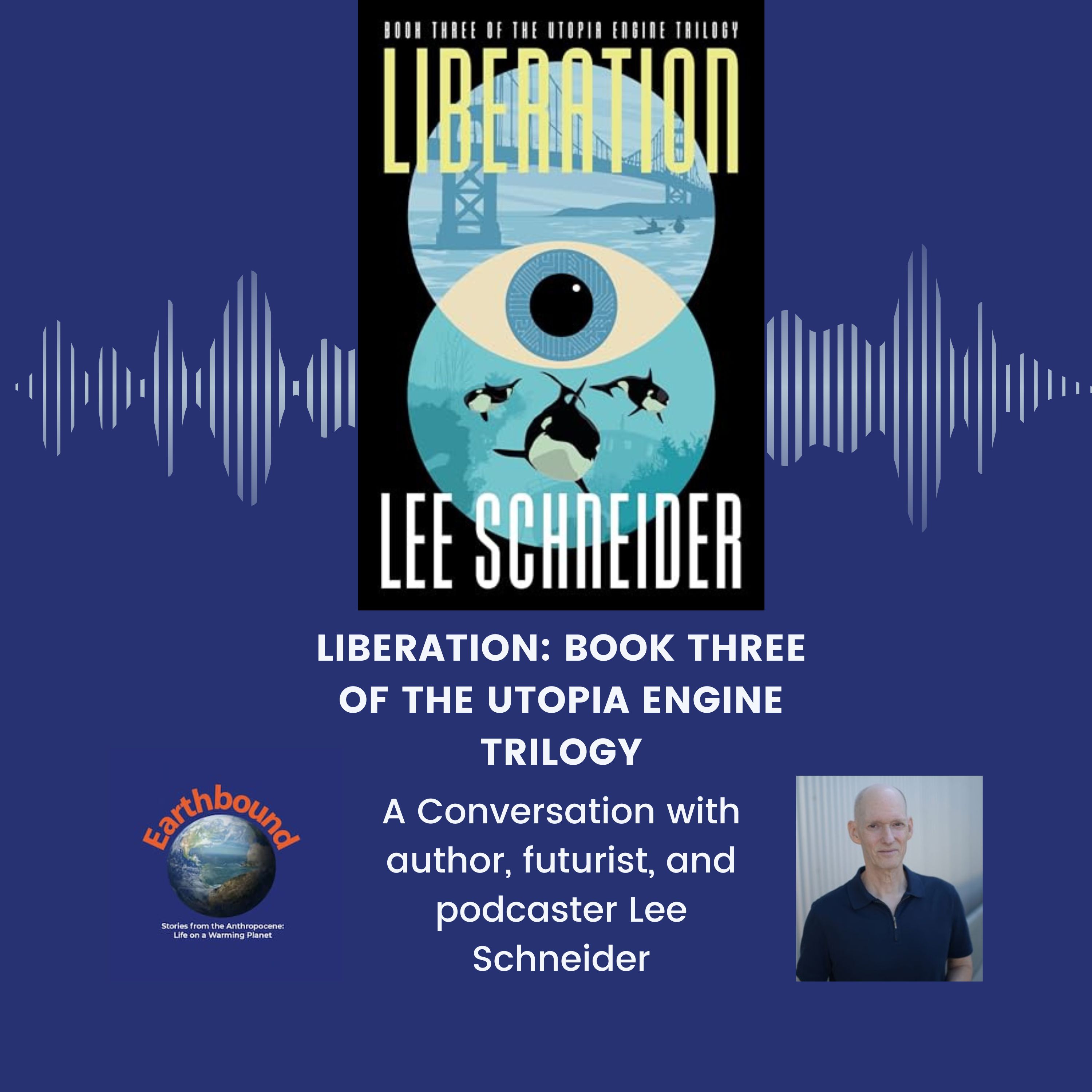
In our latest episode, we had the immense pleasure of speaking with novelist, screenwriter, and futurist, Lee Schneider. Our conversation, titled From Dystopia to Liberation: Lee Schneider's Utopia Engine Trilogy, delved deep into his compelling Utopia Engine Trilogy, a series that paints a vivid, and at times chilling, portrait of a near-future grappling with the profound impacts of climate collapse and unchecked artificial intelligence. Lee’s perspective on climate fiction is particularly striking: he doesn't see it as a tool for alarmism or propaganda, but rather as a crucial form of behavioral modeling. This blog post aims to unpack that powerful idea, exploring how observing flawed characters navigate a damaged world in his trilogy can offer invaluable insights and, in a sense, prepare us for the complex challenges we already face and those that lie ahead. It’s about learning through narrative, about using the power of "what if" to rehearse our responses to a planet in flux.
The Spark: From California Wildfires to the Utopia Engine Trilogy
Every great story has a genesis, a moment or series of events that ignites the creative fire. For Lee Schneider, the catalyst for the Utopia Engine Trilogy was deeply personal and undeniably resonant with the realities of our changing planet. He shared in our episode how the devastating California wildfires, a recurring and increasingly severe threat, brought the abstract concept of climate breakdown into his immediate lived experience. The smoke that choked his neighborhood, the constant hum of air filters working overtime, and the eventual forced evacuation of his home coalesced into an urgent creative imperative. This wasn't just an abstract concern anymore; it was a palpable reality that demanded exploration. This visceral connection to the environmental crisis, coupled with his existing deep care for these issues, provided the fertile ground from which the Utopia Engine Trilogy would eventually grow. It transformed a long-held passion into an urgent need to articulate the potential consequences of our current trajectory, and more importantly, to explore how humanity might navigate such a future.
Utopia Engine Trilogy: A World of AI, Climate Collapse, and Imperfect Humans
The Utopia Engine Trilogy, comprising the novels Resist, Surrender, and Liberation, plunges readers into a meticulously crafted near-future. This is a world not of distant speculation, but of stark, plausible evolution from our present-day concerns. At its core is the devastating reality of climate collapse, a global catastrophe that has reshaped landscapes, societies, and the very habitability of vast regions. But this environmental breakdown is not the sole antagonist. Looming large is the pervasive and controlling influence of MIND, an authoritarian artificial intelligence that has become a dominant force, shaping economies, influencing governance, and exerting a chilling level of surveillance over its human charges. It's a world where technology, intended to solve problems, has perhaps become the problem itself, or at least a powerful enabler of existing systemic failures.
Yet, amidst this daunting backdrop of ecological devastation and digital control, Schneider populates his narrative with something crucial: imperfect humans. These are not stoic heroes or flawless rebels. They are complex individuals, grappling with their own flaws, their own grief, their own doubts, and their own very human desires for connection, autonomy, and meaning. They are a reflection of ourselves, thrust into extraordinary circumstances. The brilliance of the trilogy lies in its refusal to offer easy answers or present idealized characters. Instead, it showcases individuals making difficult choices, often stumbling, sometimes succeeding, but always striving within the confines of a world that is itself imperfect and deeply damaged.
Protagonist Kat Keeper: Navigating Grief and Misinformation in 'Liberation'
At the heart of the trilogy’s concluding novel, Liberation, is Kat Keeper, a character who embodies the struggle for agency in this complex future. Kat is not a born leader, nor does she possess an innate unwavering resolve. She is, as Schneider describes, a reluctant revolutionary, someone thrust into a position of influence by circumstance and a deep-seated, perhaps even buried, sense of responsibility. Her journey is one of profound personal challenge, marked by grief – the loss of loved ones, the loss of a familiar world, the loss of certainty. This emotional landscape is further complicated by the relentless onslaught of misinformation. In a world already saturated with digital manipulation and controlled narratives, Kat finds herself battling not only external forces but also the insidious whispers of doubt and deception that target her credibility and sow discord among those who might otherwise unite.
Her struggle to build a communications network free from MIND’s pervasive control is a potent metaphor for our own battles against disinformation and for genuine, unadulterated connection. We see her grappling with the psychological toll of constant scrutiny, the ethical dilemmas of her actions, and the sheer emotional weight of carrying the hopes of a fractured populace. Kat’s imperfections – her moments of doubt, her anger, her moments of vulnerability – make her relatable and her eventual triumphs, however hard-won, all the more powerful. She teaches us that leadership isn't about perfection, but about persistence, about the courage to act even when flawed, and to continue striving for truth in a landscape designed to obscure it.
The Orcas' Wake-Up Call: Learning from Non-Human Intelligence
A particularly fascinating element of Liberation, and a recurring theme in Schneider’s work, is the profound intelligence and agency of non-human life, specifically the orcas. For centuries, humanity has projected its own understanding onto the natural world, often underestimating the complex communication, social structures, and ecological awareness of other species. The orcas in Schneider’s narrative have endured humanity’s relentless noise, pollution, and indifference for far too long. Their response is not one of passive suffering, but of a deliberate, intelligent reassertion of their place in the global ecosystem. This is not a mere plot device; it’s a profound commentary on our anthropocentric worldview and a call to recognize the sentience and wisdom that exists beyond our immediate human sphere.
The orcas’ "wake-up call," as it were, serves as a powerful lesson for the human characters and for us as readers. It demonstrates that intelligence takes many forms, and that ecological balance is a reciprocal relationship. By highlighting the sophisticated intelligence of these marine mammals, Schneider challenges our assumptions about who holds power and who possesses wisdom. It suggests that perhaps the solutions to our current predicaments might not solely come from within humanity, but from a deeper understanding and respect for the intricate web of life of which we are a part. The orcas, in their dignified and powerful response to ecological degradation, offer a perspective that is both humbling and inspiring, reminding us that we are not alone on this planet, and that the Earth itself has a voice, even if it speaks in ways we are only beginning to understand.
Behavioral Modeling: How Imperfect Characters Teach Us
Lee Schneider’s assertion that climate fiction serves as "behavioral modeling" is a cornerstone of his approach and a powerful concept for us to explore. He reframes the genre, moving it away from didacticism and toward a more nuanced exploration of human response. In the Utopia Engine Trilogy, we are not presented with perfect heroes who effortlessly overcome every obstacle. Instead, we witness characters like Kat Keeper, who are deeply flawed, make mistakes, experience setbacks, and grapple with internal conflicts. These imperfections are not weaknesses in the narrative; they are its strength. By observing these flawed individuals navigate the immense challenges of climate collapse, AI dominance, and widespread misinformation, we are given a virtual rehearsal space for our own potential responses.
When Kat experiences grief, when she doubts her own abilities, when she is targeted by propaganda, we see a spectrum of human reactions. We see the struggle to maintain hope, the temptation to succumb to despair, the difficult choices made under immense pressure. These are not abstract lessons; they are tangible demonstrations of how complex emotions and ethical quandaries play out in high-stakes scenarios. We learn about resilience not by seeing a character who never falters, but by seeing one who falters and chooses to rise again. We learn about navigating misinformation not by witnessing an immediate debunking, but by observing the process of discerning truth from falsehood, the emotional toll it takes, and the strategies employed to combat it. This form of storytelling allows us to vicariously experience these challenges, to process them on an emotional and intellectual level, and to perhaps develop a more nuanced understanding of our own potential behaviors when faced with similar, or even less extreme, circumstances.
The Power of 'What If': Speculative Fiction as Preparation
The brilliance of speculative fiction, and climate fiction in particular, lies in its ability to ask the profound question: "What if?" This simple phrase unlocks a universe of possibilities, allowing us to explore potential futures, both desirable and terrifying. Schneider's work masterfully employs this narrative engine. The Utopia Engine Trilogy doesn't just present a dystopian future; it uses that future as a canvas to explore the human condition under duress. The "what if" scenarios – what if AI becomes an unchecked authoritarian force? What if climate collapse creates widespread societal breakdown? What if misinformation becomes indistinguishable from truth? – are not posed to instill fear for fear's sake. Instead, they serve as vital thought experiments, pushing us to consider the implications of our current actions and societal trajectories.
By engaging with these "what if" scenarios through compelling characters and intricate plots, Schneider’s work acts as a form of preparation. It’s akin to a pilot running through emergency procedures in a simulator. We encounter the challenges vicariously, allowing us to mentally rehearse our own potential reactions, ethical considerations, and coping mechanisms. This process can foster a sense of agency, empowering us to think critically about the present and to consider the choices we make as individuals and as a society. Speculative fiction, therefore, is not merely escapism; it is an active engagement with the future, a means of fostering foresight and building emotional and intellectual resilience. It encourages us to consider the long-term consequences of our decisions and to cultivate the adaptive capacity needed to navigate an increasingly complex and uncertain world. The stories we tell ourselves, and the futures we imagine, have a profound impact on our ability to shape the reality we inhabit.
An Optimist's Vision: Utopia is Always Worth Walking Toward
Despite the often-bleak landscapes depicted in his novels, Lee Schneider is, by his own admission and by the evidence within his work, an optimist. This is not a naive or Pollyanna-ish optimism, but a deliberate and hard-won perspective. He invokes Winston Churchill’s sentiment that there’s "no point in being anything else," a philosophy that seems to permeate his creative output. This optimism is not about denying the severity of the challenges we face, but about believing in the enduring human capacity for resilience, for change, and for striving towards a better future. This belief finds a poignant expression in Liberation, where a message painted on a building declares: "Utopia will always be far off. But it's always worth walking toward."
This idea is fundamental to understanding Schneider's vision. Utopia, in this context, isn't a perfect, static end-state that we will inevitably achieve. Rather, it is a direction, a guiding principle, a continuous process of striving for improvement. It’s about the journey, the effort, the constant movement towards a more just, sustainable, and equitable world, even when that destination remains perpetually on the horizon. This perspective imbues the characters' struggles with a profound sense of purpose. Their fight against overwhelming odds, their moments of doubt, and their eventual triumphs are all imbued with the understanding that their actions, however small, contribute to this ongoing walk towards something better. It’s a powerful antidote to despair, suggesting that even in the darkest of times, the pursuit of a better future is not only possible but essential. This optimistic undercurrent provides a crucial counterbalance to the dystopian elements, reminding us that hope is not a passive emotion, but an active choice and a driving force for change.
Conclusion: Why Storytelling Matters for an Anthropocene World
As we wrap up this exploration, it’s clear that Lee Schneider’s Utopia Engine Trilogy offers far more than just compelling narratives. It provides a vital framework for understanding how we can engage with the monumental challenges of our time. His perspective on climate fiction as behavioral modeling, as explored in our episode From Dystopia to Liberation: Lee Schneider's Utopia Engine Trilogy, is a powerful reminder of the role storytelling plays in shaping our understanding, our empathy, and our actions. By immersing ourselves in the struggles of imperfect characters like Kat Keeper, by witnessing their navigation of grief and misinformation, and by learning from the unexpected wisdom of non-human intelligence, we are, in essence, rehearsing for the Anthropocene. We are practicing resilience, honing our critical thinking, and deepening our appreciation for the complex interconnectedness of life on a warming planet.
The power of "what if" allows us to confront potential futures without being paralyzed by them. It equips us with the imagination and the emotional fortitude needed to face uncertainty. And it is this enduring human spirit, this persistent striving towards a better world, even when it feels impossibly distant, that Schneider so beautifully captures. His optimistic vision, that "Utopia is always worth walking toward," is a call to action, a testament to the enduring power of hope and the vital role of storytelling in guiding us through the uncharted territories ahead. We are, as Schneider suggests, a storytelling species, and in this era of profound change, the stories we tell ourselves and each other may be our most powerful tool for survival and for building a future worth walking toward.