
 Apple Podcasts
 Spotify
 PocketCasts
 RSS Feed
 YouTube
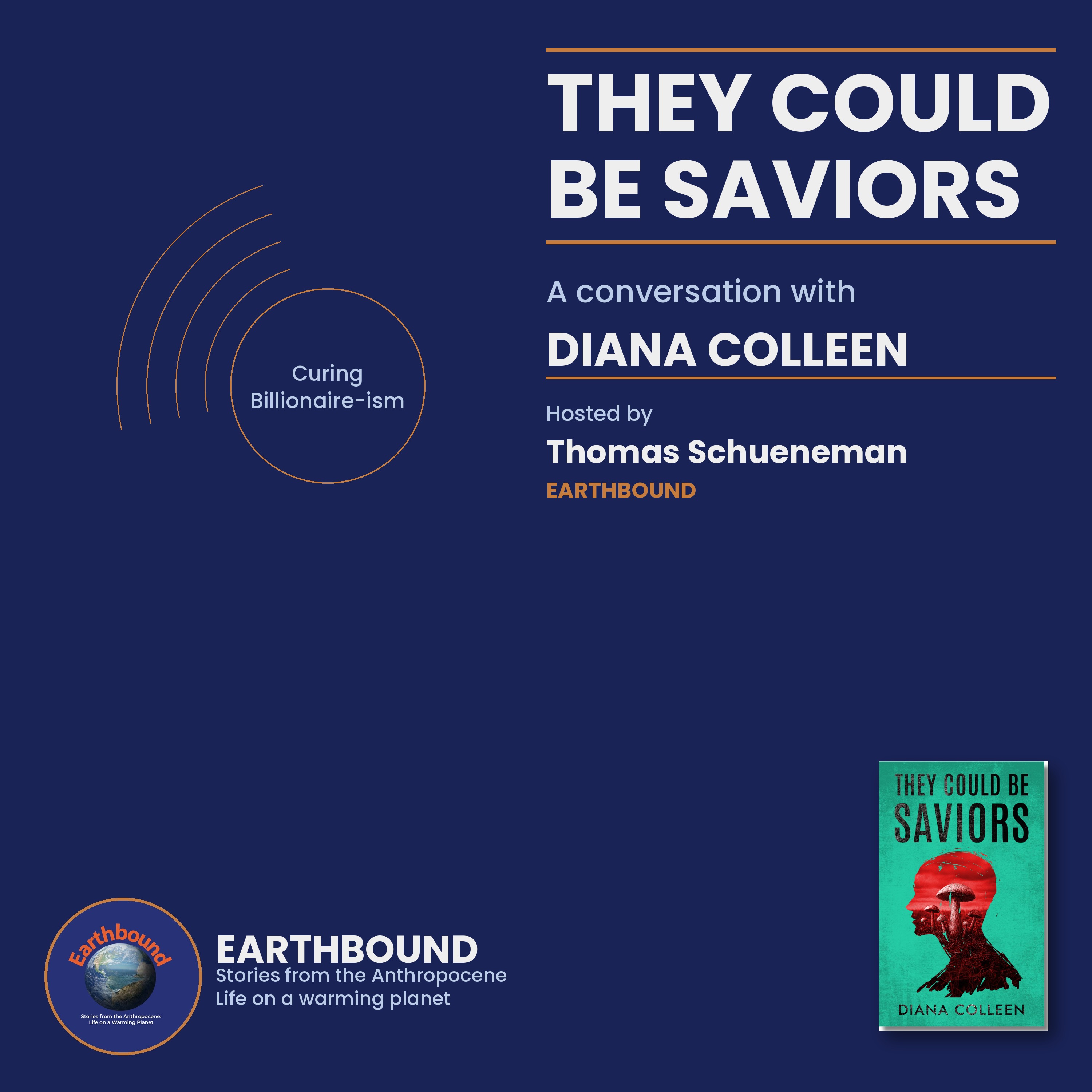
 Diana Colleen: They Could Be Saviors | Curing Billionaire-ism
What if the problem isn’t that the people with the most power don’t care? What if it’s that they’ve lost the capacity to?
That’s the question at the center of Diana Colleen’s debut novel, They Could Be Saviors. A group of the world’s wealthiest men is kidnapped and brought to a facility where they’re offered a choice: undergo psychedelic-assisted therapy, or stay put indefinitely. It sounds far-fetched. Spend a few minutes with the headlines, and it starts to feel less like science fiction and more like a thought experiment we should have started a long time ago.
Diana is an author, a trained psychedelic therapy facilitator, and a self-described democratic socialist. In 2018, she hit rock bottom and found her way to an underground facilitator who, she says, saved her life. That experience is the bedrock of her novel.
The book frames the billionaire class not as villainy but as pathology. A taker mentality writ large, scaled across centuries and obscene accumulations of capital. But it’s also an argument for reconnection. These men are still human beings. They’ve had trauma. They can change, if something happens to shake them loose from the story they’ve been telling themselves. That’s where the psychedelics come in.
We talked about the carbon footprint myth, the corrosive design of social media addiction, the feminist architecture of the story, and what any of us can actually do right now. Your voice, Diana says, is your power.
And then she told a story about a barista having a bad day, and how one small act of kindness ripples outward in ways we can’t always see. It sounds small. But it’s also how the world turns.
Takeaways:
- Billionairism is a pathology, not just a policy problem. Extreme wealth concentration isn't simply an economic issue. Diana frames it as a mental illness, a hoarding disorder scaled to planetary consequence, that severs its hosts from the shared reality the rest of us navigate every day.
- The carbon footprint narrative is a diversion. The idea that individual consumer choices are the primary lever for addressing climate change was largely engineered by fossil fuel interests to shift blame downward. Changing the behavior of a few thousand people at the top would do more than changing the habits of eight billion at the bottom.
- Psychedelic therapy is not recreational drug use. Set and setting make all the difference. Therapeutic use is built on intention, preparation, and a held, safe environment. That distinction matters, and the suppression of legitimate research since the Nixon era has cost us decades of potential progress.
- Hope is the consequence of action, not its prerequisite. Waiting to feel hopeful before doing something has it backward. Engagement, however modest, is what generates the sense that change is possible. Disengaging entirely may protect your mental health in the short term, but it removes you from the work.
- Small acts of kindness are not trivial. They ripple. The barista story isn't a consolation prize for people who can't do bigger things. It’s a genuine theory of change, grounded in how human beings actually affect one another.
Resources:
- Diana Colleen: They Could Be Saviors
- The Parado Principle (80/20)
- Daniel Quinn: Ishmael
- Earthbound Podcast
- GlobalWarmingIsReal
- Eartbound Listener Survey
00:00 - Untitled
00:21 - Exploring Psychedelic Therapy for Climate Change
02:55 - The Influence of Billionaires on Climate Change
15:03 - The Impact of Psychedelic Therapy on Personal Transformation
27:50 - The Impact of Billionaireism on Society
33:50 - The Impact of Technology on Society
37:41 - The Hope for Change
46:38 - The Power of Kindness
Tom
00:00:06.960 - 00:06:22.460
My guest today on Earthbound is Diana Colleen. Diana is an author, a trained psychedelic therapy facilitator and a self described democratic socialist.
All elements that inform the premise of her book they could be saviors.
In her novel, billionaires are kidnapped and brought to a facility where they're offered psychedelic assisted therapy to dissolve their egos and reconnect to humanity and nature in order to address climate change. They're not forced into therapy. They do have a choice. Participate or everyone stays put forever.
The billionaires along with their facilitators, who are ready to guide them on their journey.
The female staff isn't interested in seeking recognition for themselves for saving the world, but understands the natural tendencies of these captains of industry even after their ID egos are dissolved. It's risky and ethically challenging, but perhaps the best shot at averting climate chaos in a disconnected world.
It might seem like there's a lot to unpack in this premise. Kidnapped billionaires, semi forced to take psychedelics so they're care enough to solve climate change. That sounds a little crazy, right?
But not really. Open your mind to the possibilities.
In fact, Colleen lets us imagine the path towards sanity alongside our billionaire protagonists when we step back for a second and see a world increasingly run by a sliver of humanity detached from humankind, believing they bear no responsibility for the consequences of their detachment, their irrational hoarding, their cancerous thirst for wealth and power, and their delusion of being untouchable gods among men. Even as that delusion, hubris and avarice spill out to the rest of us planet we all must share.
Colleen frames billionairesm as a mental disease like hoarding on steroids and ketamine. A taker's mentality writ large. Think of our favorites, Musk, Bezos, Zuck, Altman, Karp and the rest.
They all have immense, even grotesque wealth, power and influence. They have all jettisoned themselves from the everyday world that you and I inhabit.
And yet their actions press in on our daily lives in myriad ways, trying to sell us on distraction, isolation, fear, and the seeds of our own destruction.
Such men, and they're all men proffering their wildly outsized control, make those of us left in the real world of cause and effect, of consequences, unshielded by wealth, feel powerless to affect meaningful change. It's not that their power, influence and wealth are ephemeral.
It's that they're riding on top of a house of cards, their self importance fed by sycophancy, still living on Earth, but on another planet nonetheless. When a Category 5 hurricane devastates a community who is the most likely to suffer the greatest impact? Not the billionaires.
When a record breaking firestorm levels a town whose home is lost with nowhere to go. Not the billionaires. When a rising sea washes away a Pacific island, who loses the very ground beneath their feet? Not the billionaires.
And so the responsibility of facing a climate changed world falls disproportionately on you and me.
We're directed to watch our carbon footprint while being lectured by people whose feet barely touch the ground, told to avoid that one flight, the plastic fork, the small occasional luxury in an otherwise relatively simple life.
Sure, if we all reuse and recycle, always refuse the plastic fork, only climb aboard an airplane when we absolutely need to walk a mile instead of driving one. That would be nice, but for one thing, billions of people are struggling just to find food, water and health care.
And in their struggle, they are sold a bill of goods offering a good life that remains just out of reach even as they bear witness to a rapidly denuded world.
When the going gets tough, billionaires retreat to their private readouts, leaving the rest of us holding the bag in they Could Be Saviors this lopsided imbalance is turned on its head.
The billionaires in her story are movers and shakers, undoubtedly smart and driven, but like the robber barons of the late 19th century, they've lost touch with their humanity and the world they have built. They are left with a relentless drive to essentially nowhere. When is enough enough?
When do the consequences of their obsession and delusion circle back into their lives instead of spilling out into ours? How do they reconnect with their humanity and focus on their talent, influence and intelligence to make a better world?
For Colleen, psychedelic therapy is that path back to sanity in a world spiraling out of control, and she makes this assessment from personal experience. After hitting rock bottom in 2018, Diana found her way to an underground psychedelic therapy facilitator, and she says it saved her life.
Is the premise in they Could Be Saviors far fetched? Take a look at the news headlines and talk to me about farfetch'd.
Colleen adeptly handles the more fantastical elements of the story and grounds the narrative in our flawed but powerful billionaires. Their journey as they rediscover their humanity and the facilitators who guide them through an arduous path for all involved.
In the end, there is awakening, healing and hope for renewal for all of us.
Colleen's experience lends an authenticity as she describes how psychedelic therapy can break down the barriers that hold us back as individuals and as a species. She's been through hell, found a way out. And in they Could Be Saviors, she tells a poignant story of healing and optimism.
Here's my conversation with Diana Colleen, author of they Could Be Saviors. Let's start off with the idea of billionaires and how that is a disease. Would you term that as a disease?
Diana
00:06:22.460 - 00:06:23.620
I'd say it's an illness.
Tom
00:06:23.940 - 00:06:24.580
An illness?
Diana
00:06:24.820 - 00:06:26.820
Yeah, mental illness.
Tom
00:06:27.380 - 00:06:29.860
How would you describe billionaireism?
Diana
00:06:30.500 - 00:06:47.280
So I see it as hoarding on a level that affects all of us. So typically hoarding affects the person as well as their families, but it doesn't really spill out into society.
But with billionaires, it affects all of us and the planet. Okay.
Tom
00:06:47.280 - 00:07:33.340
And so billionaire ism is, I would say if you look out into the landscape that we're looking at now, we're suffering from billionaire ism right now.
Let's go to the obvious one, even trillionaire ism, I guess with Mr. Musk and his, you know, maybe 10, 15 years ago, people were seeing him as some sort of a visionary that might save the world. And now we kind of that turn on its head.
And do you think that that is a product of his personal psyche or the fact that he's become so enormously and I would say grossly wealthy, that that has kind of affected his mind and that is permeating out into society because he's such a, you know, such wealth.
Diana
00:07:33.420 - 00:08:01.480
When you become that wealthy, you are disconnected from the rest of humanity. So the people that you surround yourself with are syco.
No one's telling you that you're doing things that are harming people and everyone's just praising everything you do and you think that you're this genius and everything you do is phenomenal. So I think it's the disconnection from the rest of us that is the problem.
Tom
00:08:01.960 - 00:08:09.080
How does that affect our emotional and mental well being? When we have to live in a world that is so influenced by this.
Diana
00:08:09.400 - 00:09:11.010
Psychological illness, I think we feel powerless.
Like we look at what's going on in the world and we see these billionaires having so much influence on governments and policy that, you know, they're not even elected and they have more influence than senators and congresspeople. It's as individuals we think of the things that we can do in our own personal lives to help.
But what we can do is minuscule compared to what these bills billionaires can do. And I look at the kind of like the Pareto in principle, the 8020 principle, but this is even it's like the 0.001% versus the 99.999%.
If we can shift the behavior of 3,000 people worldwide instead of trying to shift the behavior of 8 billion people. Like which one sounds easier to you?
Tom
00:09:11.170 - 00:10:44.210
Right? Exactly.
And when we connected on, you brought up the idea of not feeling guilty for using a plastic fork kind of idea, which is interesting because I think that's a big issue is a lot of this idea that it's been put on consumers. The whole idea of the carbon footprint was pushed by fossil fuel interests to shift the blame onto the consumer.
So we feel, oh my God, I have a plastic. If you can avoid using a plastic fork, that's a good idea.
But like you say, it's whether we use one plastic fork or not for one person, it's not going to make that big of a difference. The Corsino extended out to 8 billion people, but 8 billion people aren't using plastic forks.
But my point is that I think what you in your point as well is what's easier, 3,000 people or 8 billion people? And things are skewed because it seems like the 3,000 people are telling the 8 billion people you got to do something different.
And in the meantime we're going to just run roughshod and it's powerless. And the powerlessness gets to a kind of an apathy and give up, there's nothing I can do. And so here we are.
You know, how does this connect the idea of the billionaire pathology or illness impact in your mind, efforts toward climate mitigation, climate. Just addressing, even just admitting that climate change is an issue.
Diana
00:10:44.530 - 00:12:24.660
I think the narrative has to change and that's what I hope to do with my book is changing the like right now. Like you were saying, how climate change is being put on individuals. And it's just, it's so wrong. I'll probably get some numbers wrong.
I'm not an expert in climate change for the general concept. So there's something like 100 companies worldwide that are causing 70% of global emissions.
That's 100 things like entities that if they changed it would make a huge difference. But policies, everything is being put on us. So taking shorter showers, recycling, stop using plastic straws, all that stuff. It's a diversion.
It's a total diversion because the politicians are beholden to the billionaires.
So when we see Amazon doing their pledge in 2019, their climate pledge to reduce their emissions, and now six years later, their emissions are up 40%. But the packages come, oh look, we have less Packaging. We're so great. Oh, look, we have EVs delivering your stuff.
We're doing all we can, but behind the scenes, they're still lobbying for fewer restrictions on environmental legislation. They're lobbying against it, and it's working. Look at the government. Look at the government we have right now.
And look at who was at the inauguration. Look at who is cuddling up to, you know.
Tom
00:12:24.820 - 00:12:40.240
Yeah, all the billionaires were there. Yeah, yeah. So your book is about how we address this. Let's talk about the themes in your book.
How do we get from where we just described the billionaires and the broken narrative? How do you imagine that that can get fixed?
Diana
00:12:40.640 - 00:14:06.820
My idea is a little out there, probably never going to happen.
But in the book, billionaires are kidnapped and forced into psychedelic assisted therapy so that their egos are dissolved and they can actually connect to humanity and connect to nature again. I think a lot of these billionaires have no connection whatsoever to nature. And I think that's really.
So clearly, I don't think that's going to happen. But billionaires are humans. I think we look at them as either villains or heroes. There's kind of no middle ground.
Most people have one of those two viewpoints on billionaires.
But if we look at them as human beings who, they've had their own traumas, they are who they are because of the life they've led, the choices they've made, the things that have happened to them. And as most people, we don't necessarily think, oh, I'm going to change.
Like, usually when you change, it's because something happens to make you change. Like you have an event in your life, like a cancer diagnosis or you lose a loved one, something happens and you're like, I need to do something.
I need to change myself. I need to change my life. So something needs to happen to billionaires to wake them up.
Tom
00:14:07.060 - 00:14:07.310
And.
Diana
00:14:07.620 - 00:14:32.580
And I think that is society changing the narrative, changing the way we look at billionaires, rather than looking at them as successful, looking at them like there's something wrong with that person. And if collectively that's how we view them, they might actually go, oh, huh, maybe I do need to change.
Tom
00:14:34.440 - 00:15:02.840
So you could be going along and everything, and then something, you think, everything's fine, you're a billionaire and I am rich. But then by changing the narrative that, as in your book, they're kidnapped, so that's changing their narrative.
And then you bring up the idea of the psychedelic therapy. Talk about that a little bit, just in general terms. Do you have experience with psychedelic Therapy?
Diana
00:15:03.320 - 00:17:40.550
Yeah, I'm a trained facilitator. So I grew up with way more than my share of trauma, poverty. In 2018, I hit rock bottom. I was suicidal. I thought my life was optional.
And I was very fortunate to be referred to an underground psychedelic facilitator because it is illegal in the U.S. but she, I believe she saved my life. And since then she put me into a women's circle. So now instead of having one on one therapy sessions, I'm in a women's circle.
We meet about three times a year and we journey together. So psychedelic therapy saved my life, changed my life, changed how I see the world. It connected me to humanity, it connected me to nature.
And I believe that generally that happens. For a lot of people, that happens.
So the laws worldwide really from the 40s to the 60s, there was a ton of research being done on psychedelics for mental health, especially surrounding addiction. And it was just phenomenal. The research coming out of it was incredible.
And then the Vietnam War happened and Nixon, his war on drugs, he saw psychedelics as the counterculture and that it was bad for government. He basically started the war on drugs. And everyone believed that all drugs are bad.
And around the world, all research was halted on psychedelics and the drugs were scheduled. So because they're Schedule 1 drugs, you are not allowed to do research on them.
Laws are starting to loosen up a little bit and research is resuming, but it's not going very well because. So for instance, last summer the FDA was. I don't know if I can say the names of the actual drugs, so I won't.
But the FDA was looking at legalizing a certain substance for therapeutic use and they decided not to allow it because there's no way to have a control group. So in most cases studies, you have the group that gets the medicine and one that gets the placebo.
You can't really do that with psychedelics, you know, if you're on a psychedelic. So they shut that down because of that. And I just don't see any way around that.
Tom
00:17:40.950 - 00:17:48.550
When they were doing the research in the 40s through the 60s, how did they get around that then? They. Or were they just not concerned about the control group idea?
Diana
00:17:48.790 - 00:17:58.700
Yeah, you know, like the control group was kind of the people getting talk therapy versus psychedelic therapy. But you know, if you're just in talk therapy, so.
Tom
00:17:58.780 - 00:18:00.060
Yeah, yeah, yeah.
Diana
00:18:00.140 - 00:18:01.980
So you can't measure a placebo effect.
Tom
00:18:02.860 - 00:18:32.790
Which is unfortunate because everything I've read and understand about psychedelics is there is.
And I've known a couple of people that have gone through psychedelic therapy and they've said it's really, you know, not just taking psychedelics, but therapy, and it's really helped them. And that's maybe an important point between just gobbling some drugs and then having a therapy, psychedelic therapy. There is a big difference there.
And that. That's probably in the mind of people. They think it's just take. You're taking drugs and that's not what it is, right?
Diana
00:18:32.950 - 00:19:53.970
No. There's two major things that separate a recreational trip versus an assisted trip, and that's set and setting. So mindset and the settings.
Mindset is going in with intention.
So with most psychedelic therapists, you're going to have a couple of sessions prior to the day where you're journeying to get to know the therapist and talk about what you want to address.
And you write down your intentions and work through some things so that you know kind of what you're going to be working on during your journey session. Whereas, you know, if you're going to a concert or out with friends and you're, let's see some cool, cool things, you know, like, let's have some.
Some cool, trippy effects, it's a very different thing. And then the setting is basically safety.
So when you're with a therapist, even if you're having a bad trip, because bad trips do happen, but in a therapeutic setting, you have somebody there who might possibly hold your hand. They can talk you through it. They can make you feel safe even through a bad trip, which is a huge thing.
And it's a very, very different experience than just going out in the woods with your friends and eating some mushrooms.
Tom
00:19:54.450 - 00:20:23.190
So let's focus that in on that idea in your book. So these billionaires are kidnapped, and I guess they're forced, which we'll talk about in a second.
But the idea of doing that was for them to release their ego, let go of their ego. And that is a central part of psychedelic therapy is you can kind of let go of your storyline.
Diana
00:20:23.590 - 00:21:22.460
Yeah. So you really do see your life from a very different perspective. Yeah, I think we all think that we are our personality.
But you can actually change your personality. You built it. All of your choices in your life have built your personality. So we all have things happen to us.
We all have had some kind of trauma, and we can allow that to change us in many different ways. And it's our choice how to respond to those things.
And psychedelics really sort of pulls you up and you kind of look at your life from a Higher perspective and go, huh, I see what happened there. And you can really see how you responded, changed your life.
And it's not like you can go back and change your response to the things, but moving forward, you can definitely respond to things differently than you might have in the past because you've broken that story.
Tom
00:21:23.260 - 00:21:38.160
You know, there's the individual with their story, and they're. They're stuck in their story. And then we can expand that out to society and how we're kind of stuck in our story.
It's like society needs a big, huge, psychedelic therapy session.
Diana
00:21:38.400 - 00:21:39.360
Absolutely.
Tom
00:21:39.840 - 00:22:13.280
And you mentioned a couple of times, various connections to nature and a connection to other people that seems to be an endemic or a systemic problem in society. Well, both, both. But the lack of connection to nature, I think, is a big problem. And that's one of the reasons why we're here.
Here where we are, we're in the U.S. we can see that people are getting farther and farther. The connections are breaking down, and a lot of it is by design. The billionaires in charge are trying to divide us is what it feels like.
Diana
00:22:13.520 - 00:22:14.000
Yes.
Tom
00:22:14.640 - 00:22:25.120
So we kidnap the billionaires and we force them to do this therapy is forced enlightenment still. Enlightenment.
Diana
00:22:26.560 - 00:22:59.500
That's kind of one of the them. Does the end justify the means? And can you actually force somebody the whole thing? I was talking about the mindset.
If you're forcing somebody, is their mindset going to be in the right place to actually learn? So I do write around that they are not actually forced to do the therapy. They're forced to be in.
In the facility, but they're told, you know, we're not going to force you to do the therapy, but if you don't do it, you're here forever. So.
Tom
00:23:01.340 - 00:23:04.620
Still a little forced, but you have a choice.
Diana
00:23:05.420 - 00:23:20.700
And so you see how they kind of work at kind of getting to know the. The billionaires and making them kind of trust the women enough that they will do the therapy. So force. Ish.
Tom
00:23:21.180 - 00:23:26.860
Forced. Ish. Yeah. Another theme is the. I don't know if feminist might not be the right word, but the.
Diana
00:23:27.260 - 00:23:28.300
It's the right word.
Tom
00:23:28.460 - 00:23:39.340
Okay, well, let's talk about that. What is important in your story, let's talk about, in the context of the story, that it is a feminine presence that is doing this therapy.
Diana
00:23:39.740 - 00:24:36.530
Yes. Yeah. And that was very intentional. It was very intentional that all the billionaires are male and all the facilitators are female.
And there's a bit somewhere near the end where one of the billionaires is asking one of the women. Don't you want any of this? Any of the accolades? Like, don't you want any of the attention?
We're solving climate change here, and you guys are just going to go off and not be recognized for this. And the women don't care about the recognition, whereas the men are like, look at me.
You know, like, even though they've had the therapy and stuff, they still want the recognition for saving the world.
So, yeah, I think there is definitely a difference between feminist loving the world for the pure joy of loving the world and wanting to see the world healed versus, hey, I did that.
Tom
00:24:37.330 - 00:24:41.010
Yeah, well, their ego comes back a little bit, I guess.
Diana
00:24:41.010 - 00:24:41.970
Yeah. Yeah.
Tom
00:24:42.530 - 00:24:59.470
There's also the idea of, I guess that the trauma response of billionaireism would be this drive to more and more acquisition at all costs. That's the important thing. That's the emblem of success. Look what I have.
Diana
00:25:00.190 - 00:25:30.730
Exactly. And that's also, like, part of changing the narrative, not just about how we see billionaires, but about ourselves.
You know, like, we see success as somebody who has the nice car, who has the nice house, who has all the stuff, and. And we want that rather than us seeing somebody who's kind and compassionate and generous, and that's what we should be celebrating.
Those kinds of people. Like, I want more Dalai Lamas. I don't want Jeff Bezos.
Tom
00:25:31.370 - 00:25:43.290
What do you think then, about capitalism as a viable path forward? Can we accomplish what we need to accomplish in the framework of a capitalist political economy?
Diana
00:25:44.090 - 00:26:26.890
Oh, ooh, politics. I consider myself a democratic socialist. I'm from Canada, living in the US now, and capitalism scares me. It's like anything, communism, socialism.
If it's implemented incorrectly, it's going to go badly. You know, same with capitalism. It is being implemented incorrectly if in its pure form. I think it's. It's wonderful. Yes.
You know, we want people to have reasons to innovate. And if money is the reward for innovation, that's capitalism. So maybe we need to figure out different rewards. Right?
Tom
00:26:27.450 - 00:26:28.970
Yeah. Different incentives.
Diana
00:26:29.450 - 00:26:34.090
Yeah. I don't know what they might be. I haven't thought of that.
Tom
00:26:34.090 - 00:26:57.790
That's the problem. I mean, you mentioned being a democratic socialist. In my mind, that seems to be like the hybrid.
You have capitalism, but it's tempered with socialism, I guess would be the Nordic countries of Canada. I was just going to jokingly say, when you said you're Canadian in the U.S. i was going, why aren't you back in Canada?
Diana
00:26:57.950 - 00:27:03.310
Oh, believe me, I get that. My friends up in Canada are like, why are you still there?
Tom
00:27:04.830 - 00:27:43.450
Yeah, it's a frightening time in the US but then it's kind of spreading all over the world.
And it seems like the themes that you talk about in your book and just generally are there's this growing tension between finding a viable path forward and just doubling down on the worst aspects of. I mean, there are, like you mentioned, there are some great things that have come from the society that we live in.
Obviously, you and I are both living comfortable lives. I mean, it looks like you are and I am, and we're not billionaires and we don't need to be billionaires.
Diana
00:27:44.090 - 00:27:44.810
Nobody does.
Tom
00:27:45.370 - 00:28:00.300
Yeah, there's this mindset that, you know, let's go back to Musk, for instance. I don't know, he's hundreds of billions of dollars and then they're going to make him a trillionaire. I mean, that's as we're talking about that.
That's crazy. I mean, literally, that just seems crazy.
Diana
00:28:00.460 - 00:28:01.740
It is. It's insane.
Tom
00:28:02.380 - 00:28:49.170
How does that relate to you and me, the average person? What is happening in the society we're stewing in, this society that we're in? How is that impacting in your mind, general mental health?
And I'll just quickly say what I look at in the US Right now, I see a mass psychosis. I think everybody's just, even me, because I doom scroll and I go.
And I rail against it and I go, well, I can't be angry all the time, but I feel like I am sometimes. And so how do you see we're talking about billionaires, their psychosis, but what about the average person?
Diana
00:28:49.410 - 00:31:08.230
That's such a great point. And I feel it too. So, like, I tell myself, okay, I'm not going to go on social media until after, you know, I've done important things.
I don't want it to be the first thing that I see in the morning. But it's an addiction. And it is so hard not to jump on there right away. And then, like, look into the comments.
And that makes me even angrier because, like, how can that. How can I be surrounded by these kinds of people? And yeah, it's. But I think everyone right now, their mental health is suffering.
And yet we definitely, there are things that we can do as individuals to help ourselves that we're not doing because it is an addiction. And I don't think people really understand that.
It is definitely an addiction and they're making it more and more addictive and they're making it so that we are fighting each other. It is absolutely planned that way. They want us divided for our own mental health.
I think we can't disassociate completely because then we are not contributing to the change. Right. So like if, if I'm like I can't handle the world right now, I'm not going to participate at all. I'm going to do my own thing.
I'm not going to worry about what the government's doing. I'm not going to worry about what my neighbor's doing. I'm just going to take care of myself and my family and live a happy life.
Yes, your mental health is going to be a lot better but then you're not helping the change. We need people to still stay engaged so that we can change the world. Tomorrow is no Kings Day. I'm going to be there with a big sign.
It's really important to take care of yourself.
So maybe do you know take a month where you totally disconnect from social media, do a detox and see how that feels and take care of yourself that way. But stay connected in important ways.
So don't devour all the news and all the comments and everything but stay connected to like maybe choose one news source that you trust and just get your news from one place and stay connected that way.
Tom
00:31:08.630 - 00:31:09.030
Yeah.
Diana
00:31:09.030 - 00:31:10.070
And get out in nature.
Tom
00:31:10.310 - 00:31:18.550
That's true. I would get out in nature. That is the one thing when I'm like I just described when I'm all upset and everything. It's always better after a walk.
Diana
00:31:19.110 - 00:31:19.910
Absolutely.
Tom
00:31:20.950 - 00:32:00.490
I'm fortunate enough to live in a beautiful. I'm in the Monterey Bay area in California and it's beautiful here.
So I'm very for that's the other thing is to find gratitude be grateful for and also you're talking about the no kings tomorrow and there's going to be a lot of people and I think what's good about that is you're getting outside number one and then you're connecting with people. There's people right there. And when you're isolated online doom scrolling it's very isolating.
You start to feel like you're the like you said how can I be in this world with all these weird people? You start to feel like you're the only one.
Diana
00:32:01.050 - 00:32:02.330
The only sane one.
Tom
00:32:02.410 - 00:32:08.040
The only sane one. Yeah yeah. What are some of your influence Ishmael?
Diana
00:32:08.040 - 00:33:20.130
Was that Ishmael? Yes. That should be required reading for everyone.
And you were talking before about sort of how society sees itself and that book talks about the myths that society has created around ourselves and he talks about how when humans started Locking up the food. That's when the taker mentality started for humans. And the taker mentality is what has brought about billionaires.
It's like it's people thinking that they have control over necessities. It just blows my mind that we believe as humans, we believe that we have to pay to exist. Animals don't pay to exist. We are animals.
We are the only animal that has to pay for our existence. Food should not be something that we pay for. It should be available to every human being. It is necessary for our survival. It's mind blowing.
Tom
00:33:20.370 - 00:33:49.950
It's kind of like humans, if there are big brains, we're just a little too clever for our own good. It seems like sometimes, you know, we've clevered our way into this. It almost feels like we're.
And do you talk about this a little bit in your book because you do have the idea that the billionaires are trapped, but do you see society as kind of trapped as well? We're trapped in this story we told ourselves a little bit.
Diana
00:33:50.270 - 00:34:37.469
Like there's a scene about screens. I think we've become trapped by technology. Technology is. I kind of see us going in one of two directions, right?
We're either gonna go towards the Star Trek society where everyone exists without having to work. You know, like people's talents are put to use where they can be.
And it's not like anyone is forced to do the horrible stuff because we'll have technology to do the things that we don't want to do. So we'll be freed up to do the things that we want to do. So that's one direction, and then the other direction, obviously is Terminator, right?
We destroy ourselves with technology. So, yeah, I think we're becoming trapped by the technology that we have.
Tom
00:34:37.869 - 00:35:49.590
Artificial intelligence comes to mind that there's this big push in my work. You know, I'm online and stuff when I do a lot of writing and some AI message will come up, you want me to help you write? And then I don't.
You know, sometimes I'll have it help me with a social media post or something. But, yeah, it will help. You want me to help you write?
And then on the other side it'll say, do you want me to find out if this writing was done by AI? It's like, I'll help you write it and I'll help you find out if I wrote it. And it's it.
And everybody, you know, every app and every thing I use, they have. They're trying to roll out some AI. Thing. And I just. No, no, just, you know, I start yelling at the screen, just leave me alone.
I'm trying to get some work done here. Right? And that's kind of a feeling of crap. Do you wonder what's going on with this AI?
You know, I. Scrolling through the social media, I think I'm pretty good at spotting AI things, but, you know, some news items. And I go. And it's the algorithm. It's sort of trying to appeal to my sensibilities. But I go, no, man, that's fake. That's AI. That's dangerous. I think.
Diana
00:35:49.590 - 00:37:20.060
Oh, yeah. When humans tell the difference between what's real and what's not, it's really scary. It's really, really scary.
I'm terrified by AI, like, because of the way humanity has gone, you know, like, you look at all the amazing advancements we've made and what we could have done with those advances, but instead look at what we've done with them. Look at how disconnected we are from each other because of social media. Like, social media conceptually should have brought us together.
Like, oh, I can keep up with my friends who are on the East Coast. I can. You know, like, initially, that's kind of what it was when Facebook first came out. It was wonderful.
But then it turns into something completely different that is so detrimental to all of us. So as humans, we have the ability to solve climate change. We have the ability to connect with each other.
We have the ability to have machines and AI do the stuff that we don't want to do, so that we can do the stuff that humans are best at, which is create things. But we're using it in the wrong ways. And it's because the billionaires are the ones in control, and they get to decide what to do with it.
And they have decided that it's better for them if we're divided.
Tom
00:37:20.220 - 00:37:23.580
Yeah, I guess that makes money for them.
Diana
00:37:24.140 - 00:37:24.780
Exactly.
Tom
00:37:24.940 - 00:37:43.550
Because we stay engaged and we stay angry. And it gets back to the whole psychosis of billionaire ism. And I think your book tries to present some overarching ideas.
Obviously, billionaires are not likely to be kidnapped. First off, let me ask you, do you think you're an optimist?
Diana
00:37:45.630 - 00:39:16.530
I do. Like, the book is hopeful, and that's one of the things that I'm really trying to get out there, is we have to have hope.
If we don't have hope, all is lost.
And I went to see Pete Buttigieg last month, I think, and the one thing that really stuck with me, something that he said is hope is the consequence of action. So that's good. We have to do something.
You can't just sit behind a screen and put a little frame on your profile picture and say, you know, that's not going to do anything. You actually have to do something. So my way of doing something is writing a book. And not everyone's going to write a book.
But coming back to climate change and things that we can do as individuals, your voice is your power. Your voice is what's going to solve climate change. It's not you recycling and taking shorter showers. So you have to get involved.
You have to support journalists that are writing about this. You have to support the businesses that are innovating. I found out about this, it's called ecovative.
They're growing mycelium, they're making bacon out of it, they're making construction materials out of it, packaging instead of plastic. Like, why aren't those things being talked about on a grand scale?
Tom
00:39:16.930 - 00:39:17.330
Right.
Diana
00:39:17.330 - 00:39:18.930
We're not talking about the right things.
Tom
00:39:19.810 - 00:39:50.300
Right. As you alluded to that. We have. The solutions are there. We need to change the narrative around it.
And again, as we've talked about before, a lot of the narrative is you have to take a shorter shower or not use a plastic for. And then people go, eh, this isn't going to make any difference. And they kind of give up. And so the narrative is just backwards or sideways.
I don't know, it's just not right.
Diana
00:39:50.860 - 00:39:51.660
Upside down.
Tom
00:39:51.660 - 00:40:02.110
Yeah, upside down. My research said. Do you have. I pre ordered your book, by the way. I was hoping I could read it. Thank you. So I'm looking forward to reading it.
Diana
00:40:02.350 - 00:40:06.350
Well, let me send you a signed physical copy. Okay.
Tom
00:40:06.350 - 00:40:07.150
I'd love that.
Diana
00:40:07.550 - 00:40:08.030
Yeah.
Tom
00:40:08.670 - 00:40:12.030
But you use the ocean and flood imagery in the book.
Diana
00:40:12.509 - 00:40:18.590
Not a lot, but rising sea levels is mentioned a few times in my research.
Tom
00:40:18.670 - 00:40:28.600
Something came up that ocean and flood imagery were metaphors for psychological and ecological change is what I came up with.
Diana
00:40:28.600 - 00:40:29.680
Wow. Wow.
Tom
00:40:29.680 - 00:40:30.200
Okay.
Diana
00:40:31.080 - 00:40:39.400
It's funny how like people who have read the book tell me things like, oh, I love the symbolism of this and this. And I'm like, I hadn't thought of that.
Tom
00:40:39.720 - 00:40:55.640
Ah, okay. Well, see that, that's good.
I mean, because you have your ideas and then you're sparking other ideas and that can grow and people can talk and, and yeah. So you're doing something. Your activism is through your, your writing.
Diana
00:40:56.120 - 00:40:56.600
Yes.
Tom
00:40:57.080 - 00:42:18.710
And I, I get you're also a facilitator, psychedelic facilitator. That, that's. So the writing is Kind of you can reach a large audience and then you can work with individuals to help their psychology.
Yeah, yeah, because I think it's, you know, it's. It starts with individual psychology, but it's hard to change.
Well, you talk unless there's trauma, but we're living in a world of trauma, so it seems like there's change happening. Have you ever heard of a book called the Fourth Turning?
So the idea is that there are human history, cyclic, and about every 80 years or so, the span of a long human life, or average longish human life. Spanish. There's always, let's put it this way, the last Fourth Turning was in the 30s and 40s when the world went through the World War II.
And so we're about 80 years on. And so now we're into another. There's four turnings, and the fourth is radical change.
And it feels like we're in rough times right now, but we're going to emerge into a new world. And how that new world plays out is up to us. Right now, it sounds like. Seems like.
Diana
00:42:18.710 - 00:42:32.390
Yeah, yeah, no, I totally agree with that. I was kind of hoping the pandemic was going to really shift everything.
Like, as horrible as the pandemic was, I really believed that it was going to change humanity for the better.
Tom
00:42:33.350 - 00:43:19.180
Didn't. Yeah, you know, with the climate, it seemed okay. Well, you know, and of course, nobody was getting on an airplane and everybody's staying home.
And so carbon emissions went down and go, oh, see, we can do that. But now they're up. And I just read last year was carbon concentrations in the atmosphere at their highest level. It's 400 and some parts per million.
When I was born in 1958, carbon emissions were less than 300. And in my lifetime, in 66 years, almost 67. Gosh, the world has really changed.
I mean, I don't think we're really grasping how much we have altered the planet. Yeah.
Diana
00:43:19.340 - 00:43:37.720
And the people that still deny it, you know, like we have the. I can show you where humans came in, you know, like we know. Exactly. And people are like, oh, no, the Earth goes in cycles. This is totally normal.
Yes, the Earth does go in cycles, but this one is not normal. Not normal.
Tom
00:43:37.960 - 00:45:27.350
Yeah, we've completely upended the carbon cycle. You know, we pulled up all our carbon, burned it, and it's in the atmosphere, in the oceans. Yeah, that's the other thing.
Earlier this week, the climate tipping report came out and we probably reached the reefs. Yeah, it's so sad. Yeah, it's sad. I don't want to take too much more of your time.
But it's back at 10 years ago in 2015, I was in Paris for the coffee conference where the Paris agreement was signed. And at that point I thought, okay, you know, all the countries got together, everybody understood that was aspirational.
What they agreed to wasn't enough, but they agreed to do something and to come back and stock takes and ratchet up ambitions. That phrase went through the palls of cop 21. And so I came away slightly optimistic.
I also remember I was sharing a ride into the event one day, sharing a ride with a representative from the EU. This is 2015 in December. And she said, what's this about Donald Trump?
And I said, ah, don't worry, there's absolutely no way the US isn't that stupid. We're never gonna do that. And so now we're 10 years on. The pandemic happened. We're looking at COP 30. And it's just the same old thing.
I've kind of my latest newsletter, I wrote a little essay about it. The COP process has jumped the shark. It's just not, which is sad. And again, it gets back to.
I think it's important that people do actually get into a room, not just do it virtually, but get into a room and talk about it. But it's become such a. It's a spectacle and the fossil fuel interests are there and we need to change the narrative.
Diana
00:45:27.740 - 00:46:44.910
It begins with ourselves. So coming back to, you know, can one person make a difference? Absolutely, yeah.
So, like, I look back at my life and so like the therapist who saved my life, and now I've written this book that might, I'm hoping, changes the world. So was it me that's changed the world or was it her? Without her, I wouldn't be here. I wouldn't have written that book. So.
So even if you don't think that you're doing something to change the world, you might affect somebody else.
So, like, if you think about, like, going into Starbucks and the barista is having a bad day, if you are rude to her, her day is going to continue to be bad and she's going to be rude to more customers and their days are going to be bad.
But if you can stop that, if you can stop, she's having a bad day, she's been rude to me, but I'm going to be nice to her and I'm going to change her day because I'm nice to her. Then she's going to be nice to other people and they're going to have better days, so they're going to go out and be nice to more people.
So small things make a difference. And I don't think people understand that. Just be kind. Just being kind can change the world.
Tom
00:46:45.230 - 00:47:14.410
I can't think of a better way to end our conversation than that. I think that's very important. Just smile at somebody and, you know, that's happened to me.
I've been out walking and somebody will just smile and it changes my whole day. It changes my outlook. And I feel more inspired to do something positive. You know, it is.
It's like waves of positivity as opposed to waves of acquisition and division. And let's all go out and be kind to somebody.
Diana
00:47:14.650 - 00:47:17.370
Exactly. See what happens. Yes. Yeah.
Tom
00:47:17.850 - 00:47:21.250
Well, it's a great conversation. Thank you, Diana. I appreciate it.
Diana
00:47:21.250 - 00:47:24.810
Thank you so much for having me here. I've loved every minute of.
Tom
00:47:29.009 - 00:49:20.990
Might seem insignificant and trivial in all that we face in a fractured world. The smile, the gentle acknowledgement of another's humanity, the simple act of kindness.
But as the tech giants and they Could Be Saviors eventually learned compassion and empathy well up from these modest beginnings. And that is how we truly change the world for the better, for all, everywhere, all the time. We can all change the world.
Check the show notes for more about Diana Colleen, information on ordering the insightful and inspirational book they Could Be Saviors as well as other topics we discussed.
If you like what we're doing, please like and subscribe or leave us a review@earthboundpodcast.com and if you can spare a dollar or two to help keep us going, we always appreciate any of that.
Visit our website@earthboundpodcast.com or globalwarmingisreal.com and you can you can help us shape the future of Earthbound by filling out a brief listener survey. Simply go to earthboundpodcast.com/survey and let us know what you think. That link will be in the show notes as well.
Thanks for listening, dear listener. We'll see you in a couple of weeks. And in the meantime, stay safe and be kind.
